/event-detail/49856/sale-i-ancient-and-modern-glyptics

Your request has been successfully submitted.
Please check your email for further communication.
From ‘Gnostic’ to ‘magical’
Published 23/11/2026

For three centuries these stones were taken for the work of heretics from the first Christian age. Cardinals, canons, painters and antiquaries collected them, drew them, published them and sometimes had them copied. This is how Roman amulets became ‘Gnostic’, and then ‘magical’.
By Bianca Massard and Gabriele Vangelli de Cresci
Experts in Classical Antiquities and Ancient and Modern Glyptics
13 minute read
Contents
From the Middle Ages to the Renaissance
Magical gems never quite disappeared. Picked up in fields, kept in church treasuries, set on reliquaries, they came down through the Middle Ages.
The Middle Ages did not tell magical gems apart from other ancient amulets, and all were highly prized. They were set in the signet rings of the great. In 1174 an anguipede authenticated acts of King Louis VII of France. Hubert Walter, Archbishop of Canterbury, who died in 1205, was buried with a Chnoubis on his finger.
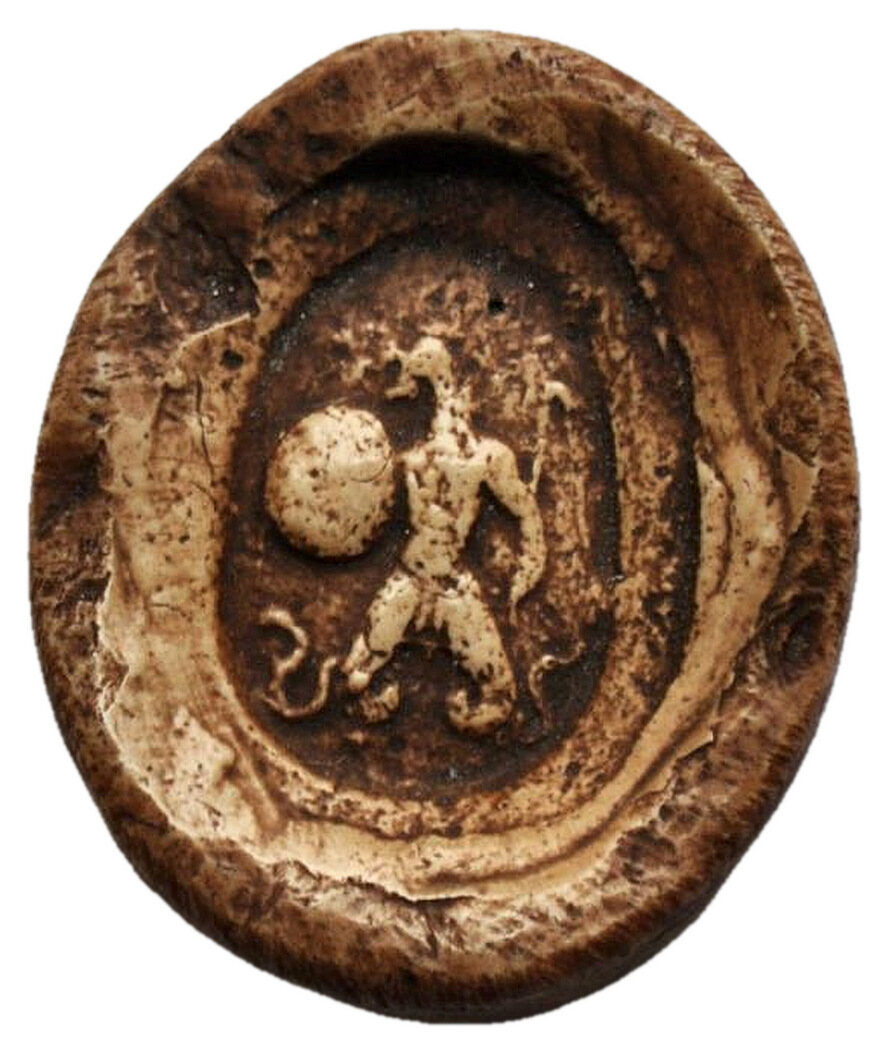
Counter-seal with the anguipede on an act of Louis VII, 1174. Wax impression, 11 × 14 mm. Paris, Archives nationales, collection des sceaux, D 37 bis.
The medieval lapidaries descended from Techel’s Liber sigillorum describe a jasper engraved with a helmeted man, shield at his neck, trampling snakes, as an amulet ‘against all enemies’. The cockerel’s head has turned into a helmet, the snake legs into a reptile underfoot.
Not all these stones were ancient. After examining the anguipede found in a bishop’s tomb at Chichester Cathedral, Árpád Nagy judges it post-antique. The stone is very rare for the type, the back is domed, the engraving polished and glossy, the shield long like a Norman one. He cautiously suggests it is medieval work.
The anguipede was already being imitated before the Renaissance.
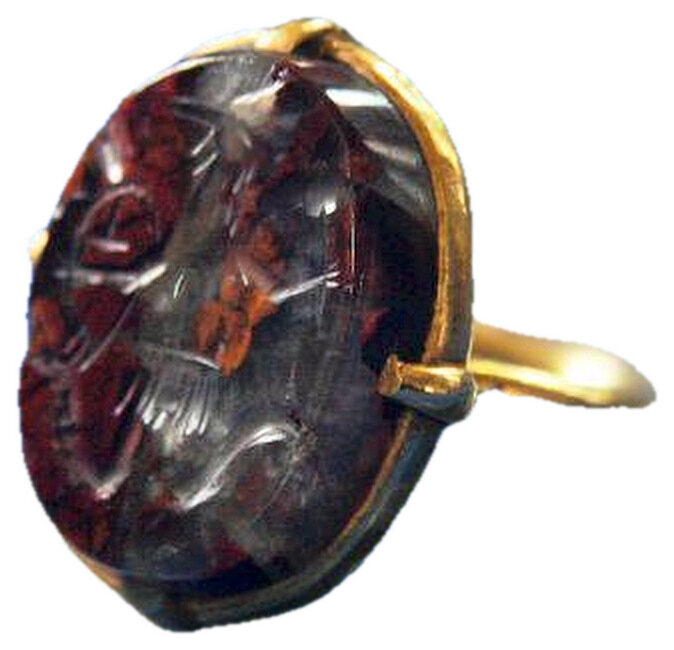
The Chichester anguipede, mounted in the Middle Ages in a gold ring. Chalcedony, 12th century (?). Chichester, Cathedral treasury.
In the sixteenth century the descriptions become accurate again. Camillo Leonardi, whose Speculum lapidum came out in Venice in 1502, describes a figure with the head of a cockerel or lion, a cuirass, snake feet, a whip and a shield. As Erika Zwierlein-Diehl notes, these texts rely directly on the gems.
The stones bear out the texts. A seal from Kolozsvár, attached to a charter of 18 June 1513, shows a post-antique anguipede cut from ancient models. It is at least forty years earlier than Pirro Ligorio’s study, the first on these gems.
Renaissance learned magic also produced new images in the manner of ancient gems. In his De vita of 1489, Marsilio Ficino writes about astrological images as a physician. The stone is to be engraved at a moment fixed by the stars. Against stings he recommends a scorpion, and against kidney trouble a lion rolling a stone under its paw.
Fabio Spadini recognises this lion as a misread ancient image. Roman intaglios often show a lion with its paw on a bull’s head, and the bull’s head has become a pebble.
Other engravers followed a book rather than a stone. A chalcedony in the Cabinet des médailles shows a pillar-shaped god standing on a dragon between two scorpions. Attilio Mastrocinque links it to a recipe in the Picatrix, repeated by Cornelius Agrippa, in which Saturn is to be shown as a man in black garments standing on a dragon. The type is dated to the seventeenth century.
Events in the sky may also have mattered. The modern fashion for Ophiuchus gems may follow the new star of 1604 in that constellation, described by Kepler.
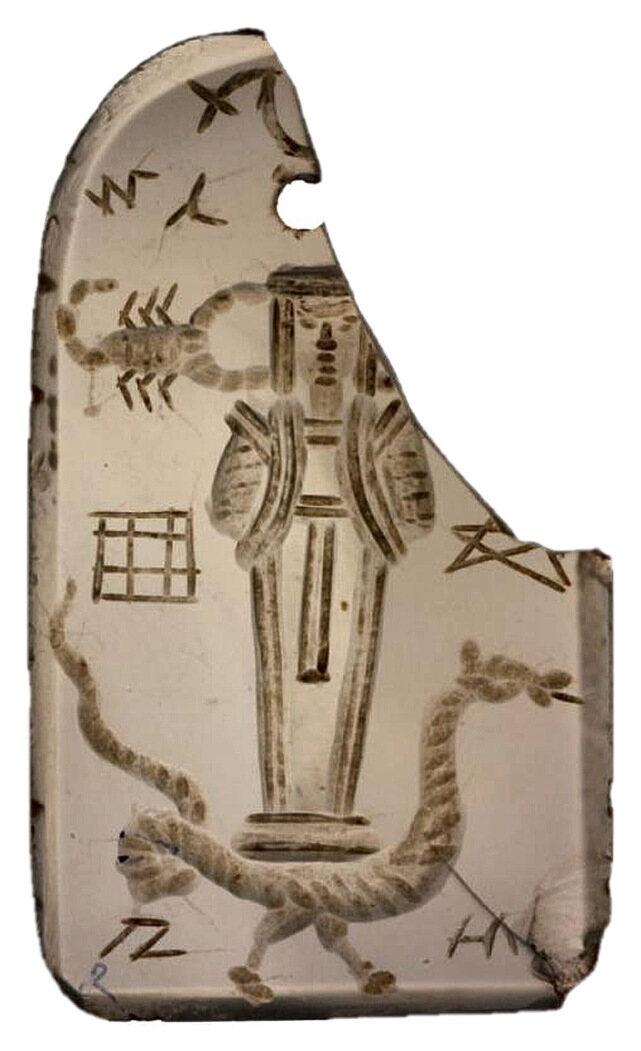
Pillar-shaped god on a dragon, between scorpions and charakteres. Chalcedony, 48 × 28.5 mm, type dated to the 17th century. Paris, BnF, Monnaies, Médailles et Antiques.
One series shows this magic at work. Three stones from the cabinet of Thomas Le Cointe, published by Chiflet and later by Montfaucon, show planets in ancient guise: the Moon seated, Jupiter with his thunderbolt, Mercury with his caduceus.
Each carries an angel’s name in Latin letters: Gabriel, Satoviel, Michael. The authors of the Sylloge Gemmarum Gnosticarum date them to the Renaissance and conclude that they came from one workshop serving one client, ‘surely very learned’: Le Cointe himself.
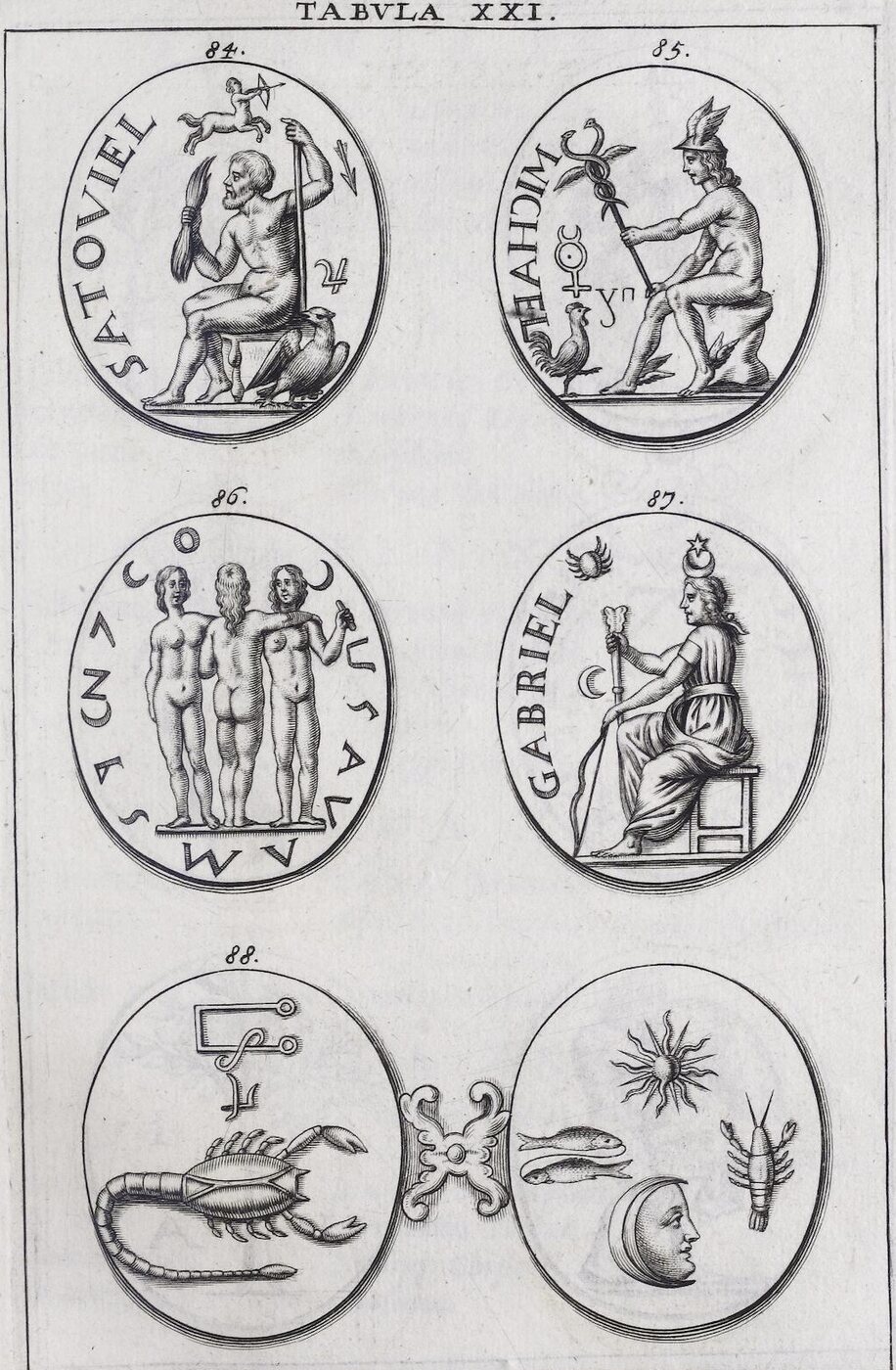
The stones from Thomas Le Cointe’s cabinet engraved by Chiflet: Jupiter with the thunderbolt, named SATOVIEL, Mercury with the caduceus, MICHAEL, the Moon seated, GABRIEL. Abraxas seu Apistopistus, Antwerp, 1657, plate XXI. Heidelberg University Library.
His collection, ‘rich in modern intaglios’, is a poor reference for any stone that comes from it.
Baronius, Chiflet and the Gnostic hypothesis
Cardinal Baronius was the first to call these gems ‘Gnostic’. At the end of the sixteenth century, in his Annales ecclesiastici under the year 120, he describes an amethyst that Fulvio Orsini took to be one of the images used by the Basilidian heretics.
Baronius was a man of the Counter-Reformation, looking in the stones for traces of ancient heresy.
The argument rested on a name. Abrasax is engraved on a great many gems, and the Church Fathers report that the followers of Basilides, in the second century, used it for the supreme God of the 365 heavens. In Greek, the numerical values of its letters add up to 365.
The debate was more open than is often claimed. Other scholars pointed out that St Jerome equated Meithras and Abrasax on the same grounds. Some concluded that Abrasax was Mithras and that the stones belonged to solar cults. Athanasius Kircher argued that Abrasax is not so much Mithras as Iao Sabaoth.
Kircher and Pignoria in the seventeenth century and Montfaucon in the eighteenth, whose real passion was Egypt, preferred ‘magical’.
How these stones are viewed, the historian Attilio Mastrocinque remarks, says as much about the viewer as about the stone.
Jean L’Heureux, known as Macarius, a canon of Aire, spent some twenty years in Rome studying ancient monuments. He died in 1614 with nothing published. His manuscript on the Basilidian gems lay in Tournai.
Jean Chiflet, a canon of the cathedral, had it printed at Antwerp in 1657, at the Plantin press. He added his own collection: 120 pieces on twenty-eight plates, an index of the gems with their owners’ names, and a commentary that arranges the stones by figure.
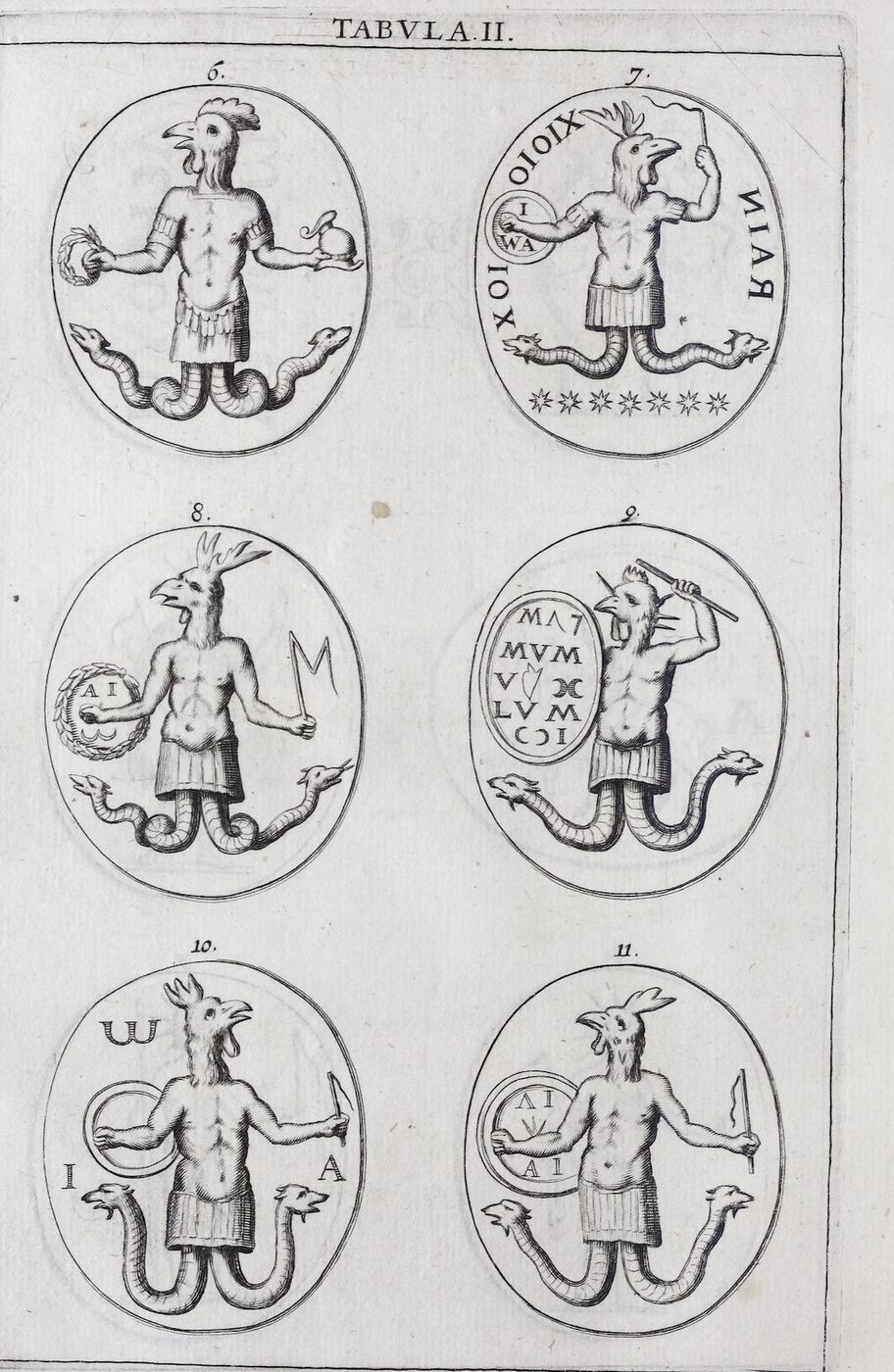
A plate from Chiflet: six anguipedes. The heads, shields, weapons and letters vary from one stone to the next. Abraxas seu Apistopistus, Antwerp, 1657, plate II. Heidelberg University Library.
The stones come from private cabinets, those of Pignoria, Gorlaeus and Philippe Chiflet. The commentary already points out engraving errors. In one place the inscription is ‘cut awry in the stone’, in another ‘the engraver’s hand faltered more than once’.
On the image, Chiflet prefers the Mithraic interpretation to Baronius’s reading. On the Hebrew names he remains a theologian. He recognises the Tetragrammaton in Iao, and in Sabaoth the biblical epithet ‘of hosts’, which he says the Gnostics mistook for the name of a power.
Peiresc, Rubens, Montfaucon: the learned cabinets
Behind these books lay a circle in which impressions, drawings and readings changed hands.
Lorenzo Pignoria collected Egyptian antiquities in Padua, and Kircher and Chiflet used his casts of gems. From Aix, Peiresc obtained gems and cameos through dealers all over the Mediterranean. By 1633 he owned two hundred amulets and magical intaglios. That year he met Kircher at Avignon.
Rubens collected them just as eagerly. His theoretical notebook, written in Italy between 1600 and 1608, mixes natural philosophy, alchemy and number mysticism. Macarius describes several stones that passed to his son Albert.

Anonymous, Rubens and his Son Albert, oil on canvas, 133.5 × 112.2 cm. In the background, a statue of triple Hecate. St Petersburg, State Hermitage Museum, inv. GE 7728.
On 7 June 1627 Peiresc told Rubens he had seen, ‘among the intaglios of these Basilidians and Gnostics’, a winged Jupiter with a thunderbolt inscribed Iao. What strikes him, in that letter, is the Hebrew name of God cut into a pagan setting.
Contemporaries were not all taken in. Around 1616–1618 Peiresc wrote to Aleandro, about a zodiac gem on which a unicorn accompanies Virgo, that he strongly suspected it was modern. He was right. The unicorn comes from the medieval Physiologus.
The Barberini circle thought these gems worth collecting, studying, ‘and sometimes even manufacturing’.
The market kept pace. In 1702 the Venetian senator Antonio Capello published the 272 intaglios in his cabinet, formed around the collection of the physician Charles Patin. He had added other stones, ‘among them some modern ones’.
When the Landgrave of Hesse wanted to buy the collection in 1701, Bernard de Montfaucon was asked to judge whether the pieces were ancient.
By about 1700, then, a scholar was already being called in to vet magical gems before a sale.
Montfaucon went on to reproduce the plates of Chiflet, Capello and several others in L’Antiquité expliquée.
From the book to the stone
A published drawing travels faster and further than a stone. An engraving by Chiflet, Kircher or Montfaucon becomes a model available to any engraver, with its merits and its mistakes. Many copies were born this way, from stone to book and from book back to stone.
The catalogues prove it. In 1720 Johann Martin von Ebermayer of Nuremberg published a Thesaurus of gems that includes stones already published by Chiflet and Kircher. His collection consisted largely of gems cut by German engravers of his own day. Winckelmann judged him harshly.
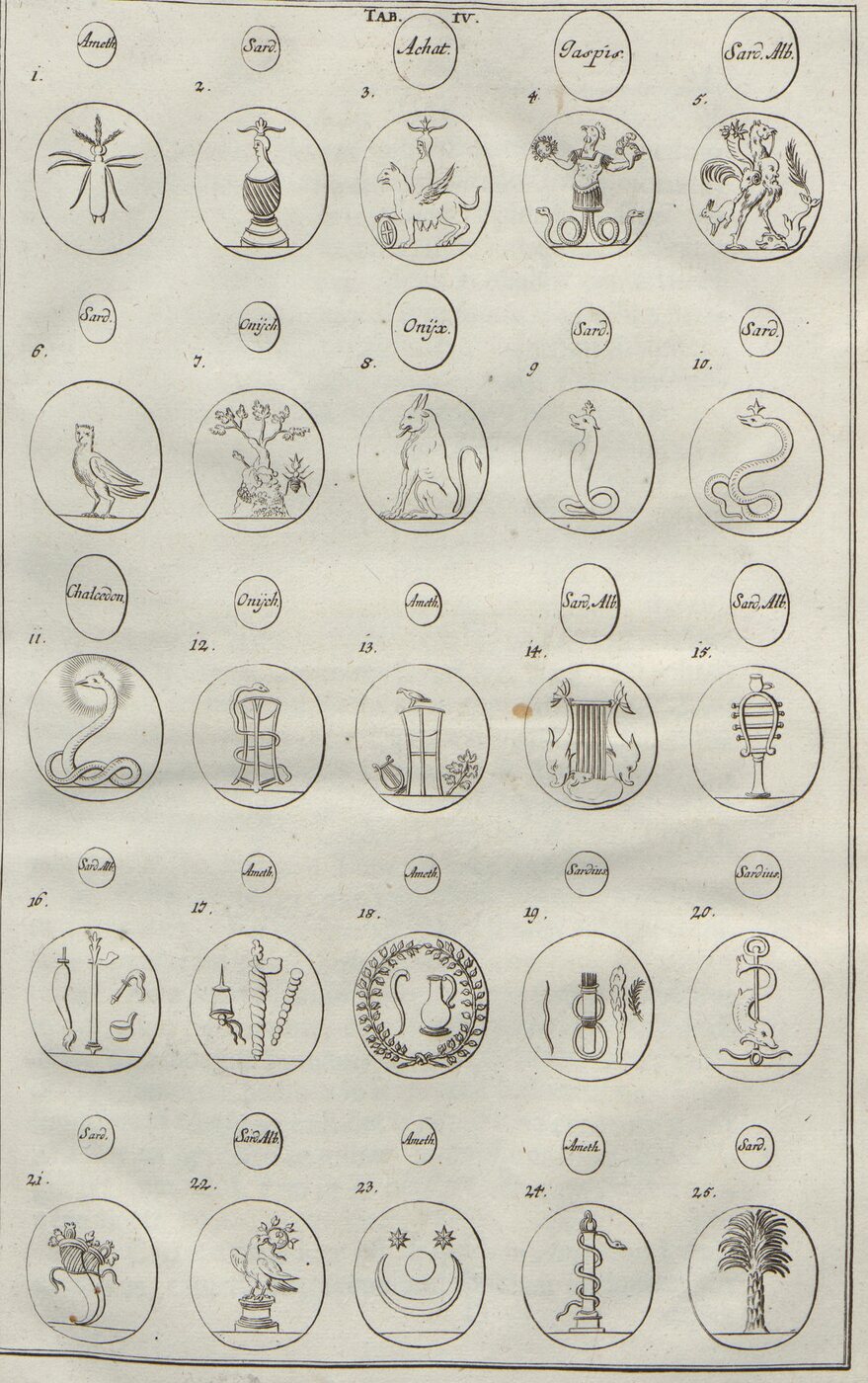
A plate from Ebermayer’s Thesaurus: twenty-five stones, each with the name of its material. J. M. von Ebermayer and J. J. Baier, Gemmarum affabre sculptarum thesaurus, Nuremberg, 1720, plate IV. Heidelberg University Library.
One stone from the Pignoria collection shows the whole chain. Known from an impression, it appears in Kircher, in Chiflet, in the reissued Gorlaeus, in Montfaucon, in Ebermayer and finally in Matter.
The Sylloge classes it as ‘modern’. The barque from which Harpocrates’ lotus rises has become a sickle blade with a shrub growing on it, and an armoured warrior stands on the shrub. For two centuries, six books reproduced an image its engraver had not understood.
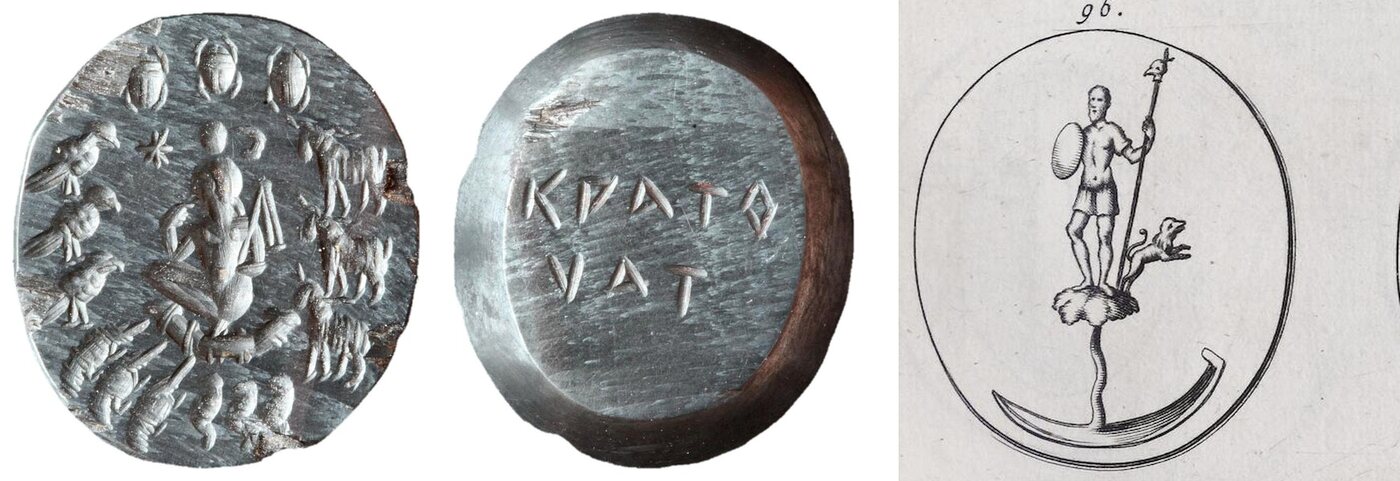
On the left, the ancient type: Harpocrates in the papyrus boat, on a haematite of the 3rd century AD (London, British Museum, inv. G 530). On the right, Pignoria’s stone engraved by Chiflet: the boat has become a sickle, the lotus a shrub, and a warrior has taken the god’s place. Abraxas seu Apistopistus, 1657, plate XXIII.
A drawing distorts, and a copy fixes the distortion. On a scorpion seal, the example Chiflet saw had already turned the animal’s tail into a lizard. The British Museum has two stones cut after his drawing.
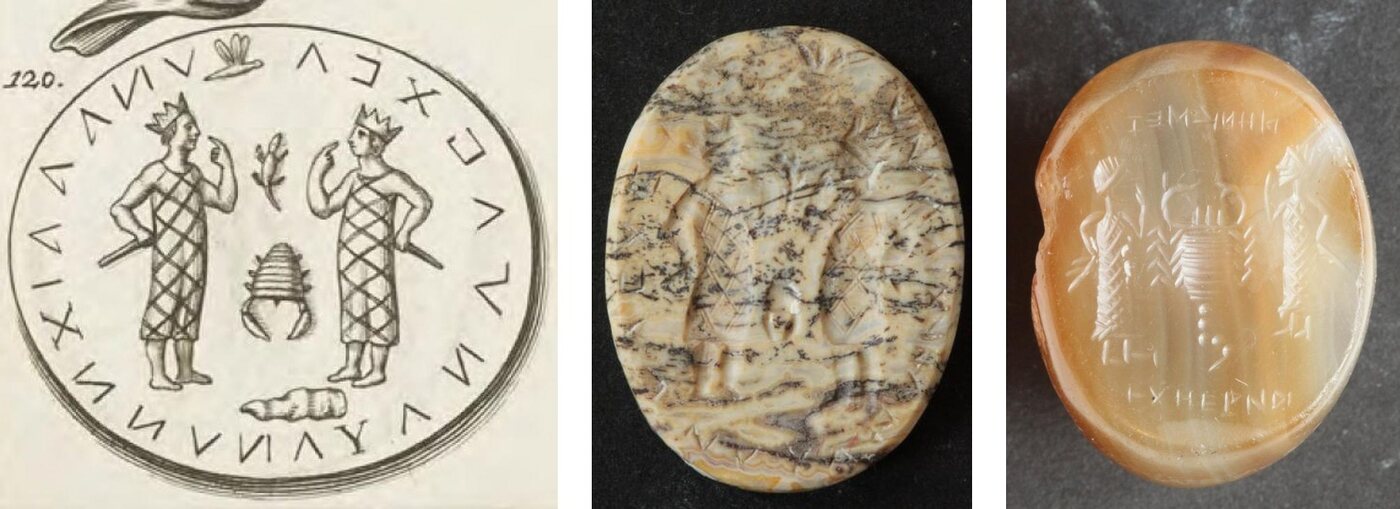
The scorpion seal. On the left, Chiflet’s drawing. In the centre and on the right, two stones in the British Museum engraved after it: marble, 22 × 17 mm, 17th–18th century (inv. G 200); chalcedony, 32 × 25 mm, 17th century (inv. G 198).
In the eighteenth century impressions made the stones travel. Cabinets had sulphurs, plasters and glass pastes cast, and collectors exchanged them like books. The collections of Baron Philipp von Stosch and the pastes of James Tassie spread thousands of them.
Glass keeps the composition. It loses the material, which gave the stone its virtue.
The collections of the nineteenth and twentieth centuries carried the process on. Wilhelm Froehner, who left some 3,540 objects to the Bibliothèque nationale and the Louvre in 1925, bought in Italy, Egypt, Cyprus and Palestine and at the Paris sales. His notebooks seldom say whether a place name refers to the findspot, the purchase or the sale.
The chalcedony with the pillar-god in the Cabinet des médailles is a telling case. This seventeenth-century stone already appears as ancient in Mariette’s Traité des pierres gravées. Salomon Reinach reproduced it in 1895, and Delatte and Derchain published it among the magical gems in 1964.
A modern stone that entered a royal collection early can acquire the pedigree of an ancient one within three centuries.
Neither an old provenance nor an early publication, then, is any guarantee.
The magical reading, from Passeri to Bonner
In the eighteenth century Giovanni Battista Passeri, in his dissertation on the Basilidian gems, put forward a third view. The amulets were made by magicians and charlatans of the imperial period, not by Gnostics or worshippers of Mithras.
In the nineteenth century Jacques Matter and Charles William King nonetheless still spoke of ‘Gnostic’ gems.
Passeri’s view prevailed once the magical papyri were published. Gems and papyri draw on the same repertoire: the same divine names, the same magical words, the same words of power.
Scholarly study begins with Armand Delatte, whose articles of 1914 tied the stones to the magicians who wrote the recipes in the papyri. Karl Preisendanz then edited the magical papyri, and in 1950 Campbell Bonner produced the first major general study.
Since then the accepted view has been that these amulets, magical rather than Gnostic, were the work of magicians of the imperial period, under Egyptian and Near Eastern influence.
Gnosticism did leave its mark on parts of the papyri, and the magic of astral names occurs in papyri, curse tablets and Gnostic texts alike. Magic can be seen as gnosis in a broad sense. But the gems were meant to protect and to heal far more than to express a doctrine.
From antiquarianism to psychology and alchemy
In Psychology and Alchemy (1944), C. G. Jung reproduces several gems after C. W. King’s book: a Harpocrates on the lotus, the serpent Chnoubis crowned with rays, a Harpocrates within the snake biting its tail. He sets the last beside the prime matter of the alchemists.
This is a psychologist’s reading, not proof of descent. More than a thousand years separate these images and, as far as we know, no ancient document links the one to the other. It does show that the second life of the amulets did not end with the antiquaries.
Frequently asked questions
Why are they called Gnostic gems?
Because Cardinal Baronius, at the end of the sixteenth century, saw in them images of the Basilidian heretics. The name Abrasax, engraved on a great many of these stones, is the one the followers of Basilides gave to the supreme God of the 365 heavens.
Who was Basilides?
Basilides of Alexandria was one of the Gnostics of the second century. According to the Church Fathers, his followers used the name Abrasax for the supreme God of the 365 heavens.
Were magical gems worn in the Middle Ages?
Yes. They were set on reliquaries and in the signet rings of the great. An anguipede authenticated acts of Louis VII in 1174, and Hubert Walter, Archbishop of Canterbury, was buried with a Chnoubis on his finger.
What is Chiflet’s book?
A collection published at Antwerp in 1657 as Abraxas seu Apistopistus. It brings together Macarius’s dissertation on the Basilidian gems and Chiflet’s own collection of 120 pieces on twenty-eight plates.
Did Rubens really collect these stones?
Yes. He traded drawings, impressions and readings with Peiresc and other antiquaries, and Macarius describes several stones that passed to his son Albert.
Is a gem published in the seventeenth century necessarily ancient?
No. The cabinets of the period also held modern stones, and the engravings in the published collections served as models for copies. An early publication is no guarantee.
When does the scholarly study of magical gems begin?
With Armand Delatte, whose articles of 1914 tied the stones to the magicians of the papyri. In 1950 Campbell Bonner produced the first major general study.
Which term should be used today?
‘Magical gems’. These amulets, magical rather than Gnostic, were meant to protect and to heal far more than to express a doctrine.
Further reading
- J. Chiflet and J. L’Heureux (Macarius), Abraxas seu Apistopistus, Antwerp, 1657.
- B. de Montfaucon, L’Antiquité expliquée et représentée en figures, Paris, 1719.
- C. W. King, The Gnostics and Their Remains, Ancient and Mediaeval, 2nd ed., London, 1887.
- C. Bonner, Studies in Magical Amulets, Chiefly Graeco-Egyptian, Ann Arbor, 1950.
- A. Mastrocinque (ed.), Sylloge Gemmarum Gnosticarum I, Rome, 2004.
- Á. M. Nagy, ‘Étude sur la transmission du savoir magique. L’histoire post-antique du schéma anguipède’, in V. Dasen and J.-M. Spieser (eds), Les savoirs magiques et leur transmission de l’Antiquité à la Renaissance, Florence, 2014.
Image sources
The photographs of the seal of Louis VII (CBd-1970), the Chichester anguipede (CBd-1570), the BnF chalcedony (CBd-3243) and the British Museum stones (CBd-526, CBd-997, CBd-998) come from the Campbell Bonner Magical Gems Database, which names the rights holders. The three plates from Chiflet and the one from Ebermayer come from the copies digitised by Heidelberg University Library. The portrait of Rubens is a photograph from the State Hermitage Museum, in the public domain (Wikimedia Commons).
Adapted from a study by Bianca Massard of Graeco-Roman magical gems (2026).
FOLLOW US ON INSTAGRAM
© 2026 ANTHEA FINE ARTS

Privacy policy
In line with government regulations regarding GDPR, below is the Privacy Policy of Anthea Fine Arts Ltd which outlines how we collect, store and process your data. If you have any questions, please contact us at customer@antheafinearts.com.
This policy applies to information held about clients and prospective clients, suppliers and prospective suppliers, contacts, and other persons about whom Anthea Fine Arts holds information. By ‘information,’ we mean personal information about you that we collect, use, share and store. In this policy, “we,” “us,” and “our” means Anthea Fine Arts Ltd, and “you” means the individual to whom the information relates.
WHAT WE COLLECT
Contact information such as your address, email address and telephone number; Proof of Residence (in the case of auctions)If relevant, your payment details / financial data i.e. your bank name, account number and sort code; Information related to your attendance of, and/or interest in, Anthea Fine Arts events, art works, artists and art fairs; Information about you that you give us in person at our auctions, events and exhibitions, by filling in cards we send you by post or forms on our site www.antheafinearts.com(our site) (e.g. the contact us section or to sign up to our mailing list) or by corresponding with us by phone, e-mail or otherwise; and Information in relation to your purchase of our merchandise or use of our services.
HOW WE COLLECT INFORMATION ABOUT YOU
Collecting information you give to us when you purchase any stock or visit us at each public auctions, or related event; Your use of the forms on our website or completion of card/forms we may provide in person or by post; From your agent or another person acting on your behalf including services such as Etsy and other art platforms and service providers.
WHAT WE DO WITH THE INFORMATION WE GATHER
We use your information to:
Provide information about our stock and Auctions services to you; Keep you informed about art, antiques, artists and events that we think you may find interesting; Carry out our obligations arising from any agreements entered into between you and us; Communicate with you Administer our site and for internal operations, including troubleshooting, data analysis, testing, marketing optimisation, research and statistical and survey purposes; Keep our site safe and secure; Comply with legal and regulatory obligations; and Security and to check your identity.
WHETHER INFORMATION HAS TO BE PROVIDED BY YOU, AND IF SO WHY
The provision of your personal details is required to sell and deliver an art work to you and for us to collect payment. If you do not provide this information we will not be able to perform our contract or enter into our contract with you and you may also be in breach of contract. We also require your personal details in order to send you marketing communications – you are not obliged to provide this information to us for this purpose.
LEGAL BASIS FOR PROCESSING
Our processing of your personal information is necessary:
For the performance of contracts to which you will be a party to and in order to take steps at your request prior to you entering into those contracts; For the purposes of legitimate interests pursued by us; or In order to comply with a legal obligation to which we are subject.
In relation to any processing of special categories of personal data, we will generally rely on obtaining specific consent from you at the time unless there is otherwise a legal requirement for us to process such information.
Where required for certain marketing activities we will obtain consent for this.
LEGITIMATE INTERESTS
Where our processing is based on the legitimate interest grounds described above, those legitimate interests are: (i) collecting personal information to provide you with a smooth and efficient client experience; (ii) to make sure you receive updated information on Anthea Fine Arts business activities; (iii) to provide the services you have requested; and (iv) for our own marketing and research.
SHARING YOUR INFORMATION
Except as expressly set out in this policy we will not sell, distribute or lease your personal information to third parties unless we have your permission or are required by law to do so. We may also share your personal information with:
Law enforcement agencies, other governmental agencies or third parties if we are required by law to do so Other business entities should we plan to merge with or be acquired by that business entity, or if we undergo a re-organisation with that entity.
TRANSFERRING YOUR INFORMATION OUTSIDE EUROPE
Your personal information may be transferred to, and stored at, a destination outside the European Economic Area (“ EEA“) and may also be processed by staff operating outside the EEA who work for us, or for one of our service providers. This may be in connection with an art fair or where we use certain offshore service providers, typically for IT and marketing services. When we, or our permitted third parties, transfer your information outside the European Economic Area, we or they will impose obligations on the recipients of that data to protect your information to the standard required in the European Economic Area or otherwise require the recipient to subscribe to international frameworks intended to enable secure data sharing. In the case of transfers by us, we may also transfer your information where: (i) the transfer is to a country deemed to provide adequate protection of your information by the European Commission; or (ii) where you have consented to the transfer. In general the safeguards we use to protect your personal information are the European Commission’s approved contract clauses, Privacy Shield where applicable and/or ensuring the country is deemed to have adequate protection. Please contact us (details below) if you wish to obtain further information about the safeguards we use for such international data transfers.
YOUR RIGHTS
At any time, you have the right (which in general is free of charge):
To request access to or a copy of any personal data which we hold about you; To rectification of your personal data, if you consider that the information we are holding is inaccurate; To ask us to delete your personal data, if you consider that we do not have the right to hold it; To withdraw consent to our processing of your personal data (to the extent such processing is based on previously obtained consent); To ask us to stop or start sending you marketing messages as described below in the marketing section; To restrict processing of your personal data; To data portability (moving some of your personal data elsewhere) in certain circumstances; To object to your personal data being processed in certain circumstances; and To not be subject to a decision based on automated processing and to have safeguards put in place if you are being profiled based on your personal data. Any request from you for access to or a copy of your personal data must be in writing and we will endeavour to respond within a reasonable period and in any event within one month in compliance with data protection legislation. We will comply with our legal obligations as regards your rights as a data subject.
We aim to ensure that the information we hold about you is accurate at all times. To assist us in ensuring that your information is up to date, do let us know if any of your personal details change at the following email address:customer@antheafinearts.com.
MARKETING
Where you are one of our clients or have otherwise provided us contact information for marketing purposes we may use your personal information to send you information by post or email about Anthea Fine Arts events, auctions, works of art and news. You can unsubscribe from receiving such communications at any time; details of how to unsubscribe from marketing emails will be included on each electronic mailing we send you.
You also have the option of “unsubscribing” from our mailing list at any time thereby disabling any further such e-mail and / or other communication from being sent to you by emailing customer@antheafinearts.com We will action any opt out request from you without delay.
Where we require your consent in order to send you certain marketing communications we will obtain this.
HOW LONG WILL WE KEEP YOUR INFORMATION?
We will only keep the information we collect about you for as long as required for the purposes set out above, for provenance/authenticity purposes or in relation to any potential disputes or as required to comply with any legal obligations to which we are subject. This will involve us periodically reviewing our files to check that information is accurate, up-to-date and still required.
Where we are entitled to send you direct marketing communications we may retain your contact information necessary for this purpose, for as long as you do not unsubscribe from receiving the same from us. If you opt out from marketing, we will retain your information to enable us to respect your wishes to not be contacted for marketing purposes.
SECURITY
We are committed to ensuring that your information is secure. In order to prevent unauthorised access or disclosure, we have put in place suitable physical, electronic and managerial procedures to safeguard and secure the information we collect online.
LINKS TO OTHER SITES
Our website may contain links to other sites, including via our social media buttons. While we try to link only to websites that share our high standards and respect for privacy, we are not responsible for the content, security, or privacy practices employed by other websites and a link does not constitute an endorsement of that website. Once you link to another website from our website you are subject to the terms and conditions of that website, including, but not limited to, its internet privacy policy and practices. Please check these policies before you submit any data to these websites. Certain features of our site may allow for social networking. You should ensure when using these features that you do not submit any personal data that you do not want to be sent, collected or used by other users, such as profile details or email address.
COMPLAINTS
Questions, comments and requests regarding this policy are welcomed and should be addressed to customer@antheafinearts.com If you have any concerns about our use of your information, you also have the right (as a UK resident) to make a complaint to the Information Commissioner’s Office, which regulates and supervises the use of personal data in the UK, via their helpline on 0303 123 1113.
HOW WE USE COOKIES
A cookie is a small file which asks permission to be placed on your computer’s hard drive. Once you agree, the file is added and the cookie helps analyse web traffic or lets you know when you visit a particular site.
We use traffic log cookies to identify which pages are being used. This helps us analyse data about web page traffic and improve our website in order to tailor it to customer needs. We only use this information for statistical analysis purposes and then the data is removed from the system.
A cookie in no way gives us access to your computer or any information about you, other than the data you choose to share with us.
You can choose to accept or decline cookies. Most web browsers automatically accept cookies, but you can usually modify your browser setting to decline cookies if you prefer. This may prevent you from taking full advantage of the website.
CHANGES TO THIS POLICY
Any changes we make to our policy in the future will be posted on this page and, where appropriate, notified to you by e-mail. Please check back frequently to see any updates or changes to our policy.
Cookie policy
This website uses cookies to ensure you get the best experience on our website.
THE TYPE OF INFORMATION WE COLLECT AND HOW.
Essential Cookies - The site owner has indicated that these are essential to the running of the site.
Cookie Guard - This cookie is essential for storing the status of your cookie choices whilst using this site.
ASP.NET Session - This cookie is used to track important logical information for the smooth operation of the site.
ASP.NET User Roles - This cookie is used to store information about authenticated user roles.
Non-Essential Cookies - The site owner has approved these cookies but you may turn them off.
Facebook - Facebook uses cookies to track the sites you visit.
Twitter- Twitter uses cookies to maintain widgets.
AddToAny does not directly set cookies. However, third-party services like Facebook, Twitter, and others may set cookies when you share content via their platforms. These cookies may track user interactions for analytics and personalization purposes. Disabling cookies will prevent social sharing functionality.
ShareThis - This cookie is set as part of the ShareThis service and monitors "click-stream" activity.
Google Analytics - These cookies are used to collect information about how visitors use our site. We use the information to compile reports and to help us improve the site. The cookies collect.
Terms & conditions for website use
October 17, 2023
The following are the terms and conditions (the "Terms") under which you (a "User") may use the website of Anthea Fine Arts (the "Company") at www.antheafinearts.com and/or any other addresses (any or all of which are herein referred to as the "Web Site"). Please read this page carefully. By accessing and using the Web Site, you accept and agree to be bound, without modification, limitation or qualification, by the Terms. The Company may, at its sole discretion, modify or revise the Terms at any time by updating the text of this page. You are bound by any such modification or revision and should therefore visit this page periodically to review the Terms.
Specific rules, in addition to these Terms, are provided with respect to transactions conducted on or in connection with the Web Site, and other rules may be provided for the use of certain other items, areas or services provided on or in connection with the Web Site, and you agree to be bound by such rules.
YOUR USE OF THE WEB SITE CONSTITUTES YOUR AGREEMENT TO ALL TERMS, CONDITIONS, AND NOTICES CONTAINED HEREIN OR OTHERWISE POSTED ON THE WEB SITE. (THE CONTENT OF SUCH AGREEMENT, INCLUSIVE OF THE TERMS AND ALL SUCH ADDITIONAL CONDITIONS AND NOTICES, ARE TOGETHER REFERRED TO HEREIN AS THE "AGREEMENT.") IF YOU DO NOT ACCEPT ANY OF THE PROVISIONS OF THE AGREEMENT, DO NOT USE THE WEB SITE.
Section 1. The Material on the Web Site
WARNING:The content of the Web Site is not intended for minors. Such content extends to a wide range of jewels, art and antiquities, is generally uncensored, and may include nudity or other graphic or literary content that some people may consider offensive, as well as access to live or electronic bidding on articles such as firearms and alcoholic beverages that may be harmful and/or illegal in the hands of minors and children and/or inappropriate for them to view or have access to. If you allow your child to use your computer, it is your responsibility to determine whether any of the services, content and subject matter displayed on the Web Site is inappropriate for your child, and to control the child's use of the computer accordingly. If you yourself find offensive content of the type referred to above, you should not use the Web Site.
The contents of the Web Site, such as text, graphics, images, audio, video, data, coding, scripts, computer programs and other material ("Material" or "Materials"), are protected by copyright under the laws of the United States as well as other countries, and are owned or controlled by the Company or by third parties that have licensed their Material to the Company. The Company authorizes you to view and download a single copy of the Material solely for your personal, noncommercial use, or in the case of dealers, to display to your clients solely for purposes of facilitating a transaction with the Company. The use of any software that is made available for downloading from the Web Site ("Software") is governed by the terms of the software license agreement accompanying such software (the "License Agreement"), and is conditioned on your agreement to be bound by the terms of the License Agreement. All rights in and to the Material not expressly granted to you in the Agreement are reserved. Neither the availability of, nor anything contained within the Web Site shall be construed as conferring any license under any of the Company's or any third party's intellectual property rights, other or further than as expressly provided in the foregoing provisions of this paragraph, whether by implication, estoppel or otherwise.
Unauthorized use of the Material may violate copyright, trademark, and other laws. You may not sell, prepare derivative works based on or modify the Material (including, without limitation, preparation of summaries of the Material or "thumbnails" of any images therein), or reproduce, publicly display, publicly perform, distribute, or otherwise use the Material in any way for any public or commercial purpose. The use of the Material or any portion thereof on any other web site, or in any publication, database, catalog or compilation, or in a networked computer environment for any purpose other than personal browsing of the Web Site without the express prior written permission of the Company is strictly prohibited. With respect to any copy you make of the Material within the scope of the limited personal license granted herein, you must retain therein, unmodified and unobscured, any and all copyright and other proprietary notices contained in the original Material. Some of the Material may contain digital "watermarks" to indicate their source and ownership. You agree not to attempt to remove, deactivate, reverse engineer, modify, tamper with or obscure any such watermarks. The trademarks, logos and service marks (the "Marks") displayed on the Web Site are owned by the Company or third parties. You are prohibited from using the Marks without the express, prior written permission of the Company or such third party. If you would like information about obtaining the Company's permission to use the Material on your web site, please email customer@antheafinearts.com.
You will not in any event use any robot, spider, scripts, service, software or any other automatic or manual device, tool, or process (a) for the purpose of compiling information regarding the identification, address or other attributes of any of our Users, bidders or sellers, or (b) to recreate in original or modified form any substantial portion of the Web Site or (c) to data mine or scrape any of the content on the Web Site, or (d) otherwise access or collect any of the Content, data, or information from the Web Site using automated means. You further agree not to (a) use services, software or any manual or automatic device, tool, or process to circumvent any restriction, condition, or technological measure that controls access to the Web Site in any way, including overriding any security feature or bypassing or circumventing any access or use controls of the Web Site, or (b) cache or archive any Content or (c) do anything that would impose an unreasonable or disproportionately large load on the Web Site, or (d) do anything that may disable, damage or change the appearance of the Web Site or interfere or attempt to interfere with the proper functioning of the Web Site or any transactions being conducted on or in connection with the Web Sites.
If you violate any provision of the Agreement, your permission to use the Material and the Web Site automatically terminates and you must immediately destroy any copies you have made of the Material.
The Company respects the intellectual property of others, and we ask our Users to do the same. If you believe that your work has been copied in a way that constitutes copyright infringement, please provide the Company's Copyright Agent the following information: an electronic or physical signature of the person authorized to act on behalf of the owner of the copyright interest a description of the copyrighted work that you claim has been infringed a description of where the Material that you claim is infringing is located on the site your address, telephone number, and e-mail address a statement by you that you have a good faith belief that the disputed use is not authorized by the copyright owner, its agent, or the law a statement by you, made under penalty of perjury, that the above information in your Notice is accurate and that you are the copyright owner or authorized to act on the copyright owner's behalf Notices of claims of copyright infringement should be directed to:
Anthea Fine Arts
111a High St Wealdstone
Harrow HA3 5DL
Attn: Director and Manager
Tel: 212-707-5941
customer@antheafinearts.com
Section 2. Privacy; User Submissions
The Company is committed to maintaining your privacy. The Company does, however, gather certain information that you provide to the Web Site. For information regarding the Company's policies for using User information please read our Privacy Policy.
The Company may provide certain areas of the Web Site (such as chat rooms, message boards or other facilities) designated as open to public access or to our Users at large (each of which is referred to herein as a "Public Area"). Generally, any communication that you post to a Public Area is considered to be non-confidential.
By posting communications (including any graphic or multimedia content) to any Public Area, you automatically grant the Company a royalty-free, perpetual, irrevocable non-exclusive license to use, reproduce, modify, publish, edit, translate, distribute, publicly perform, and publicly display the communication and any trademarks, names or likenesses therein alone or as part of compilations or other works in any form, media, or technology whether now known or hereafter developed, and to sublicense such rights through multiple tiers of sublicensees. (Provisions conferring similar rights on the Company may apply under separate terms or agreements with respect to certain matter submitted other than in Public Areas; you should check the applicable agreements or terms provided by the Company in order to ascertain your rights.)
The Company does not screen communications in advance and is not responsible for screening or monitoring material posted by Users. As a User, you are responsible for your own communications and are responsible for the consequences of their posting. You must not do any of the following things while accessing or using the Web Site or using the Material: (1) post or transmit any material unless you are the owner of all patent, trademark, copyright, trade secret or other proprietary rights ("Rights") therein, or have the permission of the owner of the Rights to post or transmit such material to the Web Site; (2) post material that otherwise violates any Rights of any third party or violates or infringes on the privacy or publicity rights of third parties; (3) post material that is obscene, defamatory, threatening, harassing, abusive, hateful, embarrassing or otherwise objectionable to another User or any other person or entity; (4) post sexually-explicit language or images; (5) post advertisements or solicitations of business; (6) post or transmit any chain letters or pyramid schemes; (7) impersonate another person or entity; (8) intentionally or unintentionally violate any applicable local, state, national or international law while using or accessing the Web Site or the Material; or (9) post or transmit any information containing a virus or other harmful component.
If notified by a User of communications that allegedly do not conform to any term of this Agreement, the Company may investigate the allegation and determine in its sole discretion whether to remove or request the removal of the communication. The Company has no liability or responsibility to Users for performance or non-performance of such activities. The Company reserves the right, in its sole discretion, to expel Users and prevent their further access to the Web Site for violating this Agreement or the law. The Company also reserves the right at all times to disclose any information as necessary or deemed desirable by the Company to satisfy any applicable law, regulation, legal process or governmental request, or to edit, refuse to post or to remove any information or materials, in whole or in part, in the Company's sole discretion.
THE COMPANY DOES NOT ENDORSE, SUPPORT, REPRESENT OR GUARANTEE THE TRUTHFULNESS, ACCURACY, OR RELIABILITY OF ANY COMMUNICATIONS POSTED BY OTHER USERS OR ENDORSE ANY OPINIONS EXPRESSED BY USERS. YOU ACKNOWLEDGE THAT ANY RELIANCE ON MATERIAL POSTED BY OTHER USERS WILL BE AT YOUR OWN RISK.
Section 3. Registration, Passwords and Signatures
In consideration of your use of the Web Site, you agree to: (a) provide true, accurate, current and complete information about yourself as prompted by any registration form that you may fill out on any Web Site (such information being the "Registration Data") and (b) maintain and promptly update the Registration Data to keep it true, accurate, current and complete. If you provide any Registration Data that is untrue, inaccurate, not current or incomplete, or the Company has grounds to suspect that such Registration Data is untrue, inaccurate, not current or incomplete, the Company has the right to suspend or terminate your account and refuse any and all current or future use of the Web Site (or any portion thereof).
You may receive a password and/or account designation, or a digital signature upon completing the registration process on the Company's Web Site. You are responsible for maintaining the confidentiality of any such password, digital signature and account, and are fully responsible for all activities that occur under your password, digital signature or account. You agree to (a) immediately notify the Company of any unauthorized use of your password, digital signature or account or any other breach of security, and (b) ensure that you exit from your account at the end of each session. The Company cannot and will not be liable for any loss or damage arising from your failure to comply with this paragraph.
We do not knowingly collect Personal Information from children under the age of 13 through the Web Site. If you are under 13, please do not give us any Personal Information. We encourage parents and legal guardians to monitor their children’s Internet usage and to help enforce our Privacy Policy by instructing their children to never provide Personal Information through any website without their permission. If you have reason to believe that a child under the age of 13 has provided Personal Information to us, please contact us, and we will endeavor to delete that information from our databases.
Section 4. Use of the Auction or Commerce Portions of the Web Site
The auction or commerce portions of the Web Site are available only to clients of the Company. This excludes in all cases minors (persons who have not reached their eighteenth birthday).
Section 5. Links to Other Sites
The Web Site may contain links to third-party web sites that are maintained by others. These links are provided solely as a convenience to you and not as an endorsement by the Company of the contents of such third-party web sites. The Company is not responsible for the content of linked third-party sites and does not make any representations regarding the content or accuracy of materials on such third-party web sites. If you decide to access linked third-party web sites, you do so at your own risk.
Section 6. Liability Disclaimers
The Material may contain inaccuracies or typographical errors. Except as may be separately specifically provided with respect to a particular sale, the Company makes no representations about the accuracy, reliability, completeness, or timeliness of the Material or about the results to be obtained from using the Web Site and the Material. Any use of the Web Site and the Material is at your own risk. Advice received via the Web Site should not be relied upon for personal, medical, legal or financial decisions and you should consult an appropriate professional for specific advice tailored to your situation. Changes are periodically made to the Web Site and may be made at any time. Some Material on the Web Site is provided by third parties and the Company shall not be held responsible for any such Material provided by third parties.
You acknowledge and agree that, in the event that there are discrepancies or differences between the descriptions of property provided on the Web Site, on the one hand, and the saleroom catalogue or saleroom addenda and announcements related to such property, on the other, the latter will in all events be considered to be authoritative and controlling.
THE COMPANY DOES NOT WARRANT THAT THE WEB SITE WILL OPERATE ERROR-FREE, CONTINUOUSLY OR WITHOUT INTERRUPTION, OR THAT THE WEB SITE OR ITS SERVER ARE FREE OF COMPUTER VIRUSES OR OTHER HARMFUL CONTENT. IF YOUR USE OF THE WEB SITE OR THE MATERIAL RESULTS IN THE NEED FOR SERVICING OR REPLACING EQUIPMENT OR DATA, THE COMPANY IS NOT RESPONSIBLE FOR THOSE COSTS.
THE WEB SITE AND MATERIAL ARE PROVIDED ON AN "AS IS" BASIS WITHOUT ANY WARRANTIES OF ANY KIND. THE COMPANY AND ITS SUPPLIERS, TO THE FULLEST EXTENT PERMITTED BY LAW, DISCLAIM ALL WARRANTIES, INCLUDING THE WARRANTY OF MERCHANTABILITY, NON-INFRINGEMENT OF PROPRIETARY OR THIRD-PARTY RIGHTS, AND THE WARRANTY OF FITNESS FOR PARTICULAR PURPOSE. THE COMPANY AND ITS SUPPLIERS MAKE NO WARRANTIES ABOUT THE ACCURACY, RELIABILITY, COMPLETENESS, OR TIMELINESS OF THE MATERIAL, SERVICES, SOFTWARE TEXT, GRAPHICS, AND LINKS. SOME STATES/ JURISDICTIONS DO NOT ALLOW THE DISCLAIMER OF IMPLIED WARRANTIES, SO THE FOREGOING DISCLAIMER MAY NOT APPLY TO YOU. THIS WARRANTY GIVES YOU SPECIFIC LEGAL RIGHTS AND YOU MAY ALSO HAVE OTHER LEGAL RIGHTS WHICH VARY DEPENDING ON YOUR STATE/JURISDICTION.
Section 7. Disclaimers of Certain Damages
IF YOU ARE DISSATISFIED WITH ANY PORTION OF THE WEB SITE, OR WITH ANY PROVISION OF THE AGREEMENT, YOUR SOLE AND EXCLUSIVE REMEDY IS TO DISCONTINUE USING THE WEB SITE. UNDER NO CIRCUMSTANCES SHALL THE COMPANY BE LIABLE TO ANY USER OR ANY THIRD PARTY ON ACCOUNT OF THAT USER'S USE OF THE WEB SITE. IN NO EVENT SHALL THE COMPANY AND/ OR ITS SUPPLIERS BE LIABLE TO YOU OR ANY SUCH THIRD PARTY FOR ANY DIRECT, INDIRECT, PUNITIVE, EXEMPLARY, INCIDENTAL, SPECIAL OR CONSEQUENTIAL DAMAGES OR ANY DAMAGES WHATSOEVER, INCLUDING, WITHOUT LIMITATION, DAMAGES FOR LOSS OF USE, DATA OR PROFITS, ARISING OUT OF OR IN ANY WAY CONNECTED WITH THE USE OR PERFORMANCE OF THE WEB SITE, THE DELAY OR INABILITY TO USE THE WEB SITE, THE PROVISION OF OR FAILURE TO PROVIDE SERVICES, OR FOR ANY INFORMATION, SOFTWARE, PRODUCTS, SERVICES AND RELATED GRAPHICS OBTAINED THROUGH THE WEB SITE, OR OTHERWISE ARISING OUT OF THE USE OF THE WEB SITE, WHETHER BASED ON CONTRACT, TORT, STRICT LIABILITY OR OTHERWISE, EVEN IF THE COMPANY OR ANY OF ITS SUPPLIERS HAS BEEN ADVISED OF THE POSSIBILITY OF DAMAGES. BECAUSE SOME STATES/JURISDICTIONS DO NOT ALLOW THE EXCLUSION OR LIMITATION OF LIABILITY FOR CONSEQUENTIAL OR INCIDENTAL DAMAGES, THE ABOVE LIMITATIONS MAY NOT APPLY TO YOU.
Section 8. Indemnity
You agree to defend, indemnify, and hold harmless the Company, its officers, directors, employees and agents, from and against any losses, liabilities, damages, costs, and expenses, including, without limitation, reasonable legal, expert and accounting fees, incurred in connection with any claims, actions or demands alleging or resulting from your use of the Material (including Software), your breach of this Agreement, or your violation of law or of the rights of any third party. The Company shall provide notice to you promptly of any such claim, suit, or proceeding and, if it is one asserted by a third party, shall provide reasonable assistance to you, at your expense, in defending any such claim, suit or proceeding.
Section 9. Import and Export Regulations Regarding Tangible Property
The United Kingdom and most foreign countries regulate the importation and exportation of tangible property. Many countries require a declaration of export for property that is leaving the country. Additionally, most countries require an Import Declaration at the time of customs clearance of property into that country. Upon import, these countries may impose duties, other taxes and/or restrictions on the property. Many countries also prohibit or restrict importation or exportation of property containing ivory, tortoiseshell, whalebone, and/or products derived from other endangered or protected species, and require special licenses or permits in order to import or export such property. Other countries regulate movement of antiquities and cultural items, which in some cases are subject to a right of pre-emption or compulsory purchase by the country from which they are to be exported. It is the responsibility of the seller to ensure that the item is properly and lawfully exported from the country in which it is located. It is the responsibility of the buyer to ensure that the property is properly imported into the buyer's country. If you participate in the auction or commerce portions of the Web site, and, as a result, purchase property that you plan to ship to another country, you agree that you are responsible for familiarizing yourself with and complying with any and all applicable rules and regulations.
THE COMPANY MAKE NO REPRESENTATION OR WARRANTY AND ACCEPTS NO LIABILITY WHATSOEVER TO THE SELLER, THE BUYER, OR ANY THIRD PARTY IN RESPECT OF THE AVAILABILITY OR ISSUANCE OF VALID IMPORT AND EXPORT PERMITS OR THE EXISTENCE OR EXERCISE OF PRE-EMPTION OR OTHER RIGHTS TO PURCHASE BY GOVERNMENTAL OR REGULATORY AUTHORITIES ANYWHERE.
Section 10. General
If any part of the Terms of Use is held unlawful or unenforceable that part shall be struck out and the remaining terms shall remain in effect. We hereby exclude to the fullest extent permitted by law, any rights of third parties.
1. Neither we, nor you, shall be liable for any failure of, or delay in, the performance of each of our respective obligations for the period that such failure or delay is due to causes beyond our respective reasonable control, including, but not limited to, acts of God, pandemics, war, fire, terrorist activity, strikes or labour disputes, embargoes, or government orders or regulation.
2. Any notice pursuant to or in connection with these Terms of Use shall be in writing and delivered by hand or by post to our registered office or by email to customer@antheafinearts.com, and in the case of us sending a notice to you, to the email address or postal address provided to us by you via our Website. Notices are deemed delivered on delivery if by hand or the third day after posting, or if delivered by email, immediately upon transmission if transmitted during normal business hours in the country of the recipient, or otherwise on the following business day.
3. The Terms of Use and any non-contractual obligations arising from or in connection with it or its subject matter or formation (including non-contractual disputes or claims), shall be governed by, and construed in accordance with the law of England and Wales and shall be subject to the non-exclusive courts of England and Wales.
Designed and powered by Masterart