/event-detail/49856/sale-i-ancient-and-modern-glyptics


Your request has been successfully submitted.
Please check your email for further communication.
How do you read a magical gem?
Published 23/11/2026

A cockerel-headed god with serpents for legs, a lion-headed snake crowned with rays, Greek letters forming words that belong to no known language. On the amulets of the Roman Empire, stone, image, name and sign were each chosen for their power. This is a guide to reading them.
By Bianca Massard and Gabriele Vangelli de Cresci
Experts in Classical Antiquities and Ancient and Modern Glyptics
16 minute read
Contents
- A world of omens
- A stone made to be read
- The material comes first
- How were these stones engraved?
- Figures to recognise
- The names: Abrasax, Iao, Sabaoth
- Charakteres: the signs that are not letters
- Turn the stone over
- Stones engraved from books
- What was the stone for?
- Where and when were they engraved?
- Frequently asked questions
A world of omens
People in Antiquity lived among omens. A stumble, the cry of a crow or an owl, a spilt jar of oil, a bad dream: anything might foretell the future.
A black dog coming into the house, a snake dropping from the roof, a beam cracking, a mouse gnawing a flour sack all boded ill. A god’s statue breaking into a sweat was worse. Against such threats, people carried protection on their person.
Roman law opposed magic from the start. The Twelve Tables, the city’s first written code, in the mid-fifth century BC, already punished anyone who bewitched another man’s crops. Pliny traces magic back to Persia and sees in it the worst of medicine, religion and astrology combined.
Yet magic and religion address the same supernatural powers, in opposite ways. Religion serves the community, magic a private need. The priest acts in public; the magician works in secret and compels the gods instead of praying to them.
Despite the penalties, every class of society used magic, emperors included. Magical gems belong to that world.
A stone made to be read
The first purpose of an engraved stone was to seal. On a seal the inscription is cut in reverse, to be read on the impression.
On magical gems the inscriptions read correctly on the stone itself. These are talismans, not seals, and they were set in rings or pendants. One anguipede was found still on its gold necklace in a tomb in Cyprus.
Three things distinguish them from ordinary intaglios. A priest or magician consecrated them. They are often engraved on both faces and sometimes on the edge. And their inscriptions are meant to be read as they stand, on the stone.
The ancients would have called them phylaktêria, protective amulets, periammata, amulets worn on the body, or pharmaka, remedies.
Most amulets were in fact papyri, less often metal strips or bronze pendants. Engraved stones were a small minority, with uses of their own. They protected the stomach and digestion, the womb, the liver and the hips, and kept off demons and scorpions.
No ancient author tells us which gems counted as magical. The category is modern. It goes back to Gorlaeus and Macarius, around 1600, and for a long time the gems were called ‘Gnostic’.
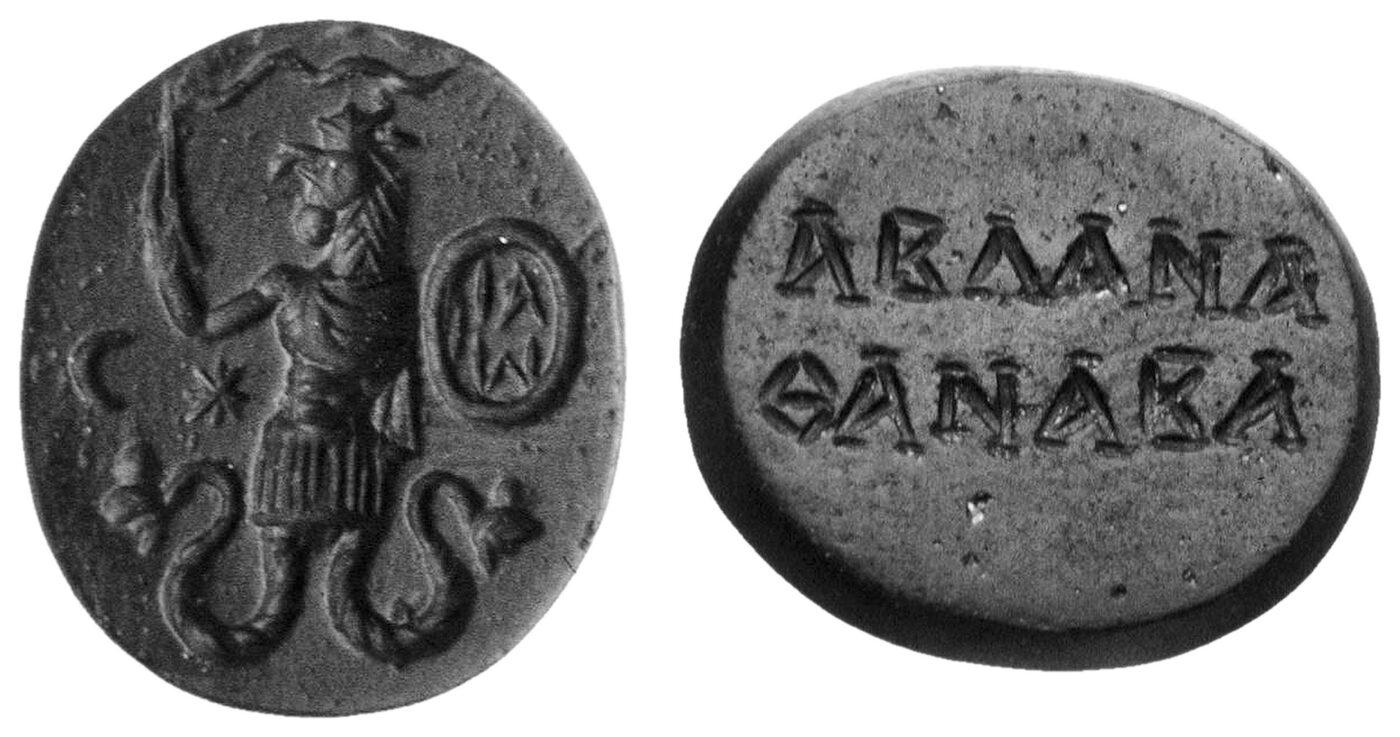
On the obverse, the cockerel-headed anguipede, whip raised, the shield marked ΙΑΩ. On the reverse, a form of the palindrome Ablanathanalba. Dark green jasper, 18.7 × 13.2 mm. Naples, Museo Archeologico Nazionale, inv. 27018/1173.
The material comes first
The stone is chosen for its powers, not its beauty.
More than a third of magical gems are jasper, red, brown, yellow or green, and about another third are haematite, a black iron ore. Lapis lazuli is also heavily used, but it is still uncommon in collections, far behind jasper and haematite.
Haematite had its own planets. The Orphic Lithica says it was born from the blood of Ouranos, castrated by his son, which links it to Saturn. Lists that match stones to planets give it to Mars, because its powder is red and it was thought of as the stone of blood.
One papyrus lists code names that temple scribes supposedly used to mislead the curious. There haematite is ‘snake’s blood’.
These stones travelled a long way. Pliny locates haematite in Ethiopia, Africa and Arabia, and says the best gold-flecked blue stone, which we identify as lapis lazuli, came from Media.
The stone was matched to the complaint. In Attilio Mastrocinque’s words, ‘for the health of the womb haematite was used, white chalcedony for milk, prase for the stomach’. The papyri also say which stone to choose: brown jasper against scorpion stings, agate against thirst.
Doctors disagreed about these stones. Galen accepts that green jasper helps the stomach but adds that it works just as well without the radiate serpent engraved on it. Soranus does not believe in amulets but tolerates them for the hope they give the patient.
The power of these stones came from colour, mineral, image and words working together.
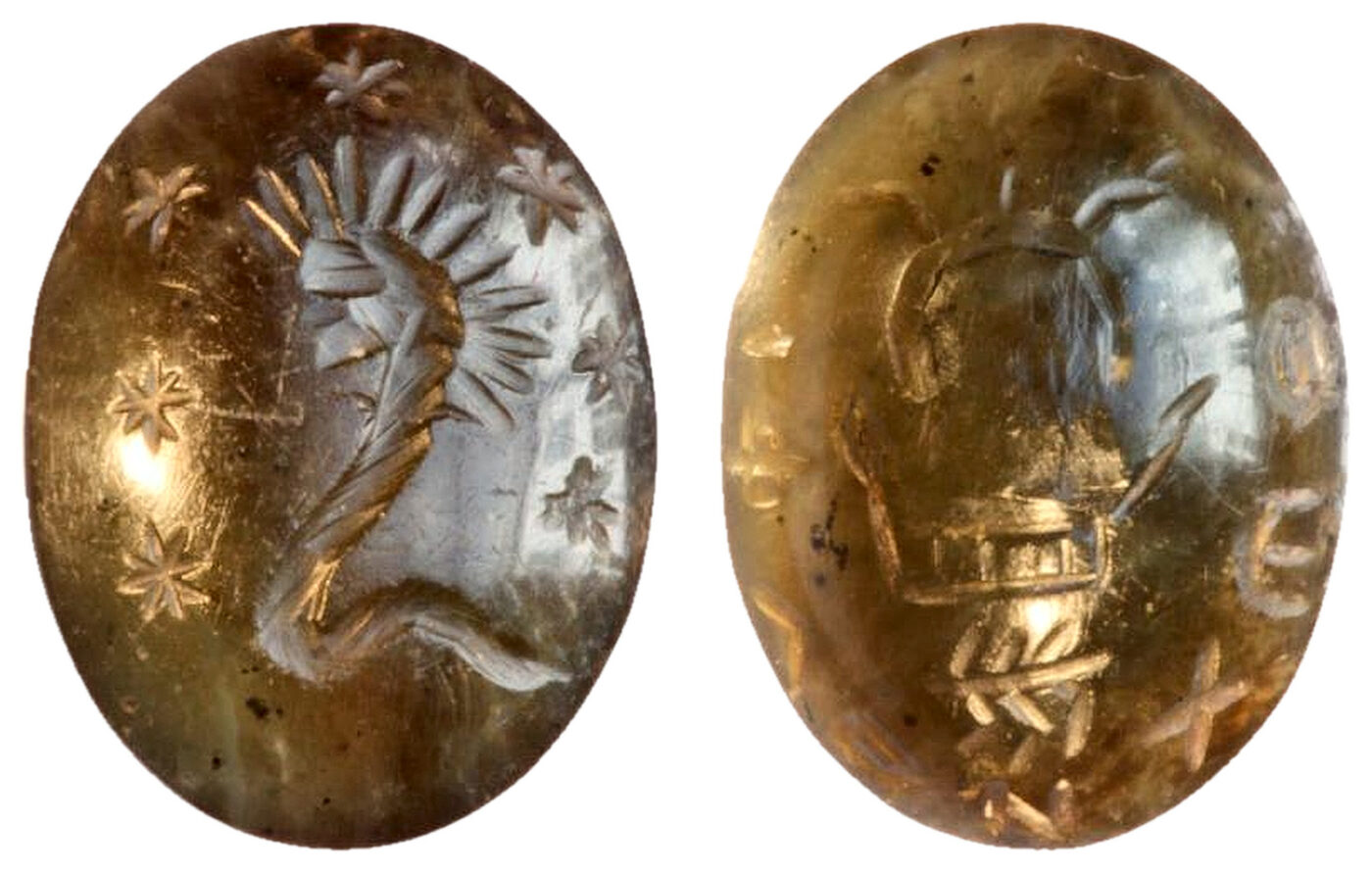
Chnoubis crowned with rays, among seven stars; on the reverse, the womb resting on its key, above the sign of Chnoubis. Prase, 15 × 12 × 6 mm. Paris, BnF, Monnaies, Médailles et Antiques, inv. 58.2187.
How were these stones engraved?
For ancient engraving we have few texts, a handful of images and, above all, the stones themselves. The technique hardly changed until the Neoclassical engravers.
The engraver began with a piece of the chosen stone: a pebble, a natural flake or a single crystal. Striking a block could shatter it or leave invisible cracks. The safest method, and the slowest, was sawing with a very thin blade, sometimes just a metal wire strung on a bow and charged with abrasive.
The blank was then ground by hand on blocks of harder rock. Finer and finer powders gave a first polish. The stone was almost always cut to shape before it was engraved.
The lathe and its drills
Soft stones could be engraved freehand. Hard stones need the wheel. The Mycenaeans knew the technique; it was revived in the Archaic period and used continuously down to Roman times.
The engraver worked at a fixed horizontal lathe driven by a bow. Its spindle took interchangeable drills, nearly always of copper or bronze. The drill heads came in every shape, ball, cone, disc or wheel, from a centimetre across to under two millimetres.
Friction heated and expanded the soft metal, which then gripped the abrasive. The abrasive was emery and, later, diamond powder, the most effective of all. The engraver held the stone against the spinning drill, and the groove took its shape from the profile of the tool, the angle and the pressure.
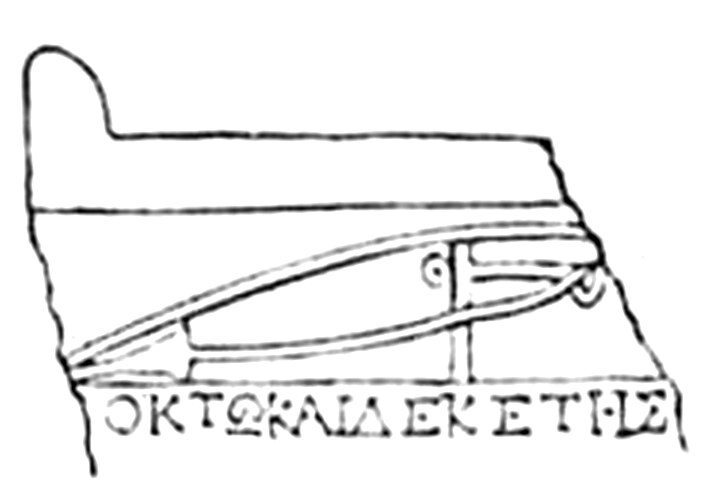
The engraver's tool on the funerary stele of Doros of Sardis, who died at eighteen: a horizontal lathe driven by a bow. Philadelphia in Lydia, 2nd century AD. Drawing after A. Furtwängler, Die antiken Gemmen, III, 1900, fig. 206. Heidelberg University Library.
The diamond point
The wheel could not produce the finest detail. Pliny mentions iron tools tipped with diamond splinters, and the grooves themselves bear this out.
A wheel leaves a U-shaped groove with rounded ends. A diamond point leaves very fine lines that end in a V, common on Hellenistic and Roman intaglios. The same points were used for the preliminary sketch.
A four-sided chalcedony left unfinished shows each face at a different stage: a quick sketch with the fine point, then forms roughed out with the wheel.
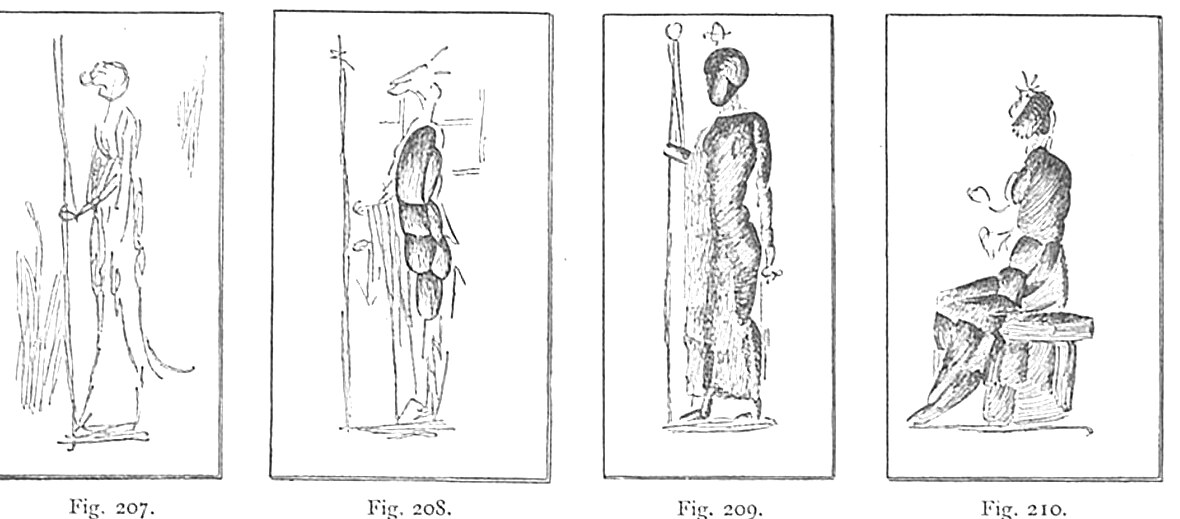
The four faces of a chalcedony left unfinished: on the left, the bare sketch with the point; then figures increasingly advanced with the wheel, up to Isis seated holding the child Horus. Hellenistic period, probably Alexandria. Drawings by C. Reichhold, enlarged four times, after A. Furtwängler, Die antiken Gemmen, III, 1900, fig. 207–210. Heidelberg University Library.
Polish and wear
Polishing came last. The face of the stone and the inside of the engraving were worked with finer and finer abrasive pastes on a soft point of bone, wood or leather. To check their work, engravers took an impression in clay or wax. There is no evidence that they used magnifying lenses.
Daily wear, knocks and sweat left the surface covered in fine scratches. Some collectors and dealers point to these as proof of authenticity. They forget that many surviving intaglios have been repolished. Wear is evidence, but never proof on its own.
On magical gems, with few exceptions, the drawing is rough and the cutting hasty.
Figures to recognise
The gods come from very different traditions, Egyptian, Near Eastern and Graeco-Roman. A warning is in order. The Egyptian gods on these gems no longer belong to Egyptian religion. They have taken on attributes from Near Eastern, Jewish and Graeco-Roman traditions.
The cockerel-headed anguipede
This is the commonest figure, and the most debated. The word anguipede comes from the Latin for ‘snake-footed’. A man with a cockerel’s head and snakes for legs, in a cuirass, brandishes a whip and holds a round shield, often inscribed. He is found on about one gem in eight. The stone is usually jasper, mostly green.
No text mentions him, and we do not know his name. Apart from the gems, he is known only from a bronze statuette at Avenches.
The most widely held view is that the figure was an attempt to picture the biblical God. The cuirass suggests the Lord of hosts and his angels, the cockerel is a bird of the sun, and the snake legs recall the Giants. The shield regularly bears the name Iao, and Genesis calls God the shield of Abraham.
No Jewish source confirms this, however. It is safer to see a syncretic figure, at once Egyptian, Jewish, Greek and Judaeo-Christian.
Is he a god or a demon? Morton Smith raised the question and noted that the gems never mention demons. Their magic is credited entirely to gods.
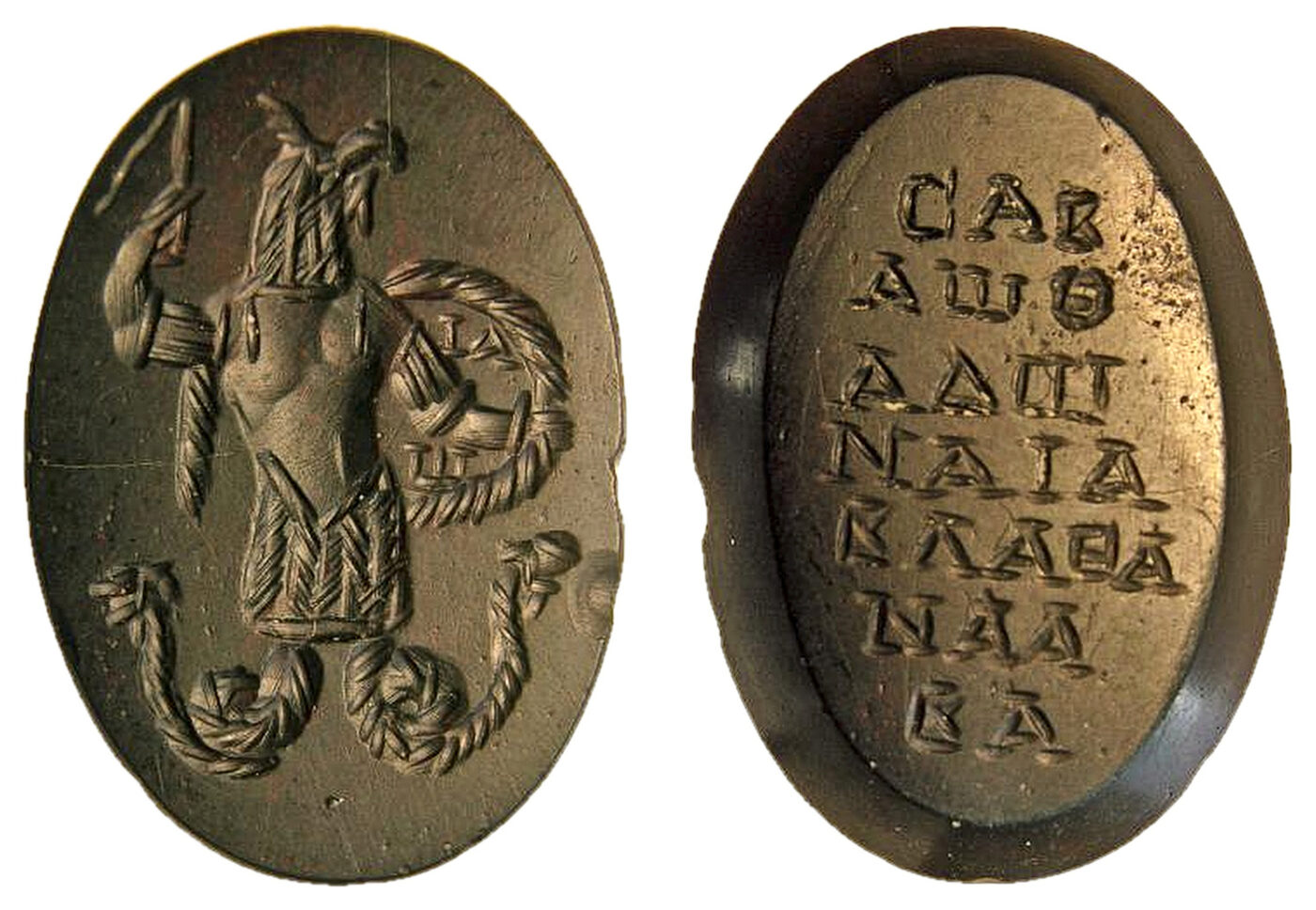
The anguipede, with whip and shield; on the reverse, ϹΑΒΑΩΘ, ΑΔΩΝΑΙ and the palindrome ΑΒΛΑΘΑΝΑΛΒΑ. Dark green jasper, 23 × 16 × 4 mm. Perugia, Museo Archeologico Nazionale dell'Umbria, inv. 1248.
Chnoubis
Chnoubis is a coiled snake with a lion’s head, often radiate. He is linked to one of the decans of the Egyptian sky, and perhaps to the god Khnum. Cut on a green stone, he protects the stomach.
One intaglio asks him to ‘keep the stomach of Proclus in good health’. Others simply order ‘digest!’.
Harpocrates
The divine child is among the commonest subjects. Son of Isis and Osiris and a solar god, he is shown as a naked child raising a finger to his lips. His name comes from the Egyptian Har-pe-khrod, ‘Horus the child’. Pliny notes that people were starting to wear his image and those of other Egyptian gods on their fingers.
Seated on the lotus, he recalls a myth from Hermopolis in which the sun is born from a lotus that rose out of the primeval chaos. The lotus closes under water at night and opens at dawn, and so stands for the daily birth of the sun.
He holds the flail. His head is radiate, with a star and crescent beside it. The lotus sometimes stands in the solar barque, among adoring baboons, falcons and animals in groups of three.
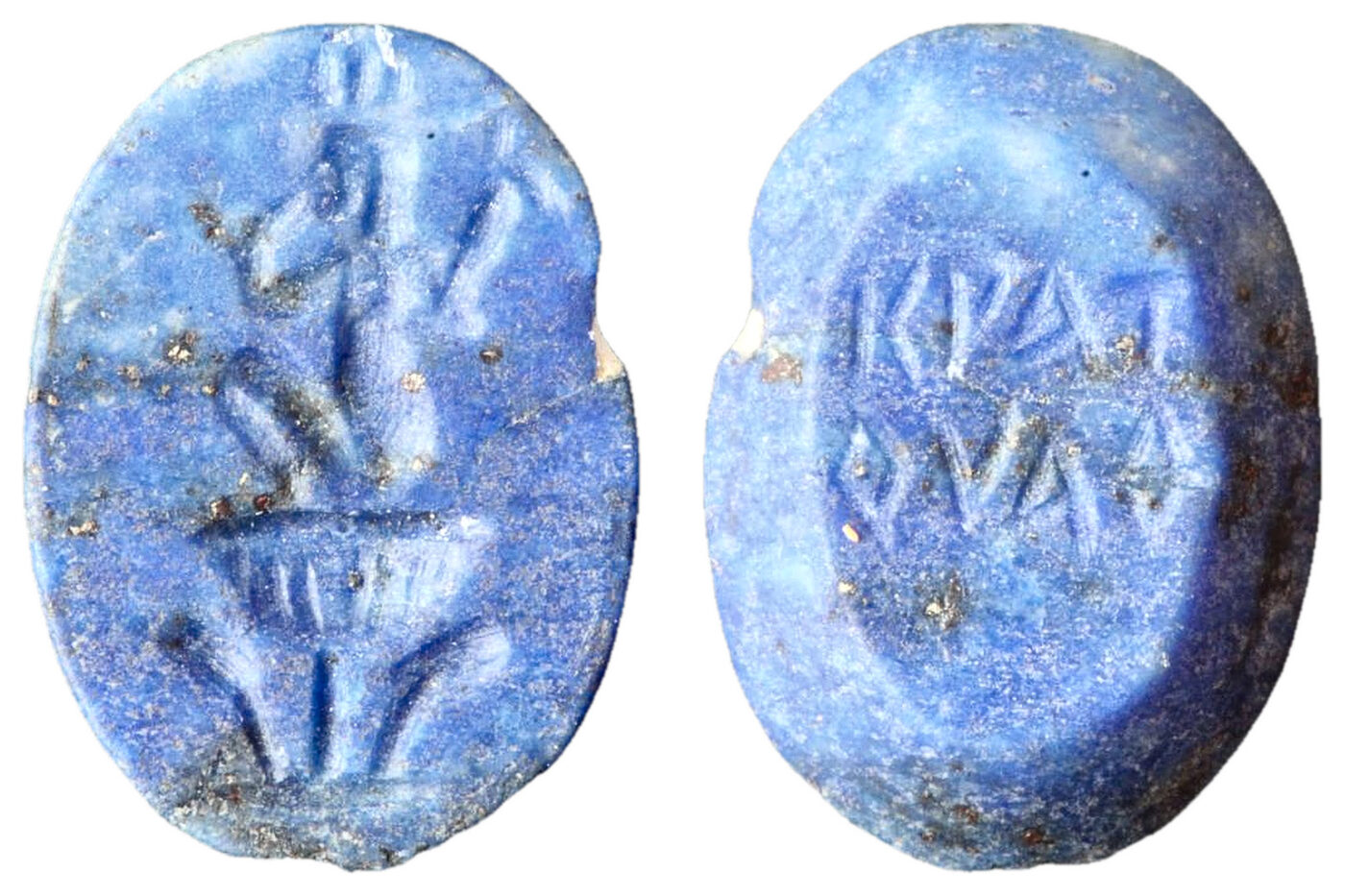
Harpocrates seated on the lotus, hand to his mouth, a cornucopia on his arm; on the reverse, ΚΡΑΤΟΥΑΘ, ‘only son’. Lapis lazuli, 13 × 10 mm, 2nd century AD. London, British Museum, inv. G 209.
Serapis
Serapis usually sits enthroned, leaning on his sceptre, with Cerberus at his feet. The first two Ptolemies had promoted his cult, and in Rome the triumvirs voted a temple to Isis and Serapis in 43 BC.
On some gems the inscriptions, and attributes such as rays or the zodiac circle, make him an all-embracing god. A consecration in the papyri closes with the acclamation ‘One is Zeus Serapis’, which is found engraved on carnelians. Other gems pair him with the name Iao, or with the names of angels.
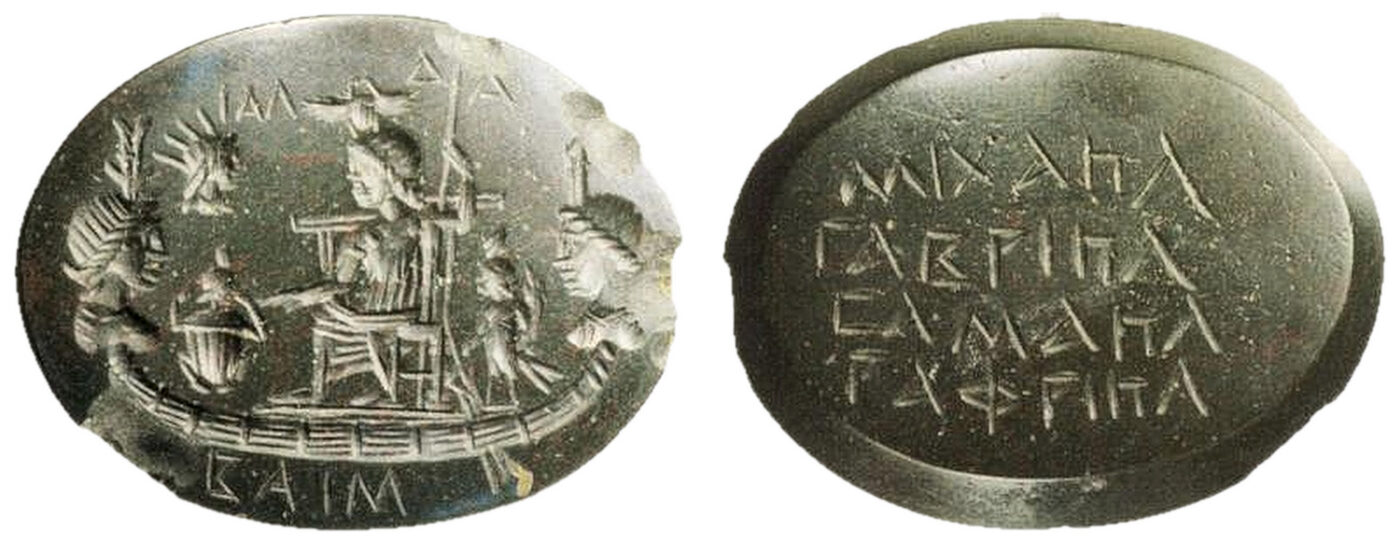
Serapis enthroned on the boat; on the reverse, the names of Michael, Gabriel, Samael and Raphael. Heliotrope, 24.1 × 30.7 mm, 2nd–3rd century AD. Hamburg, Skoluda collection, inv. M129.
Hecate
On gems Hecate is the goddess of magic above all others. She is triple, with three faces, three bodies and three pairs of arms, and holds torches, daggers and whips.
A goddess of the underworld who leads demons and ghosts, she also protects pregnant women and carries the light of the moon. The great Paris papyrus has her image engraved on a lodestone cut into a heart, with a name of twenty vowels.
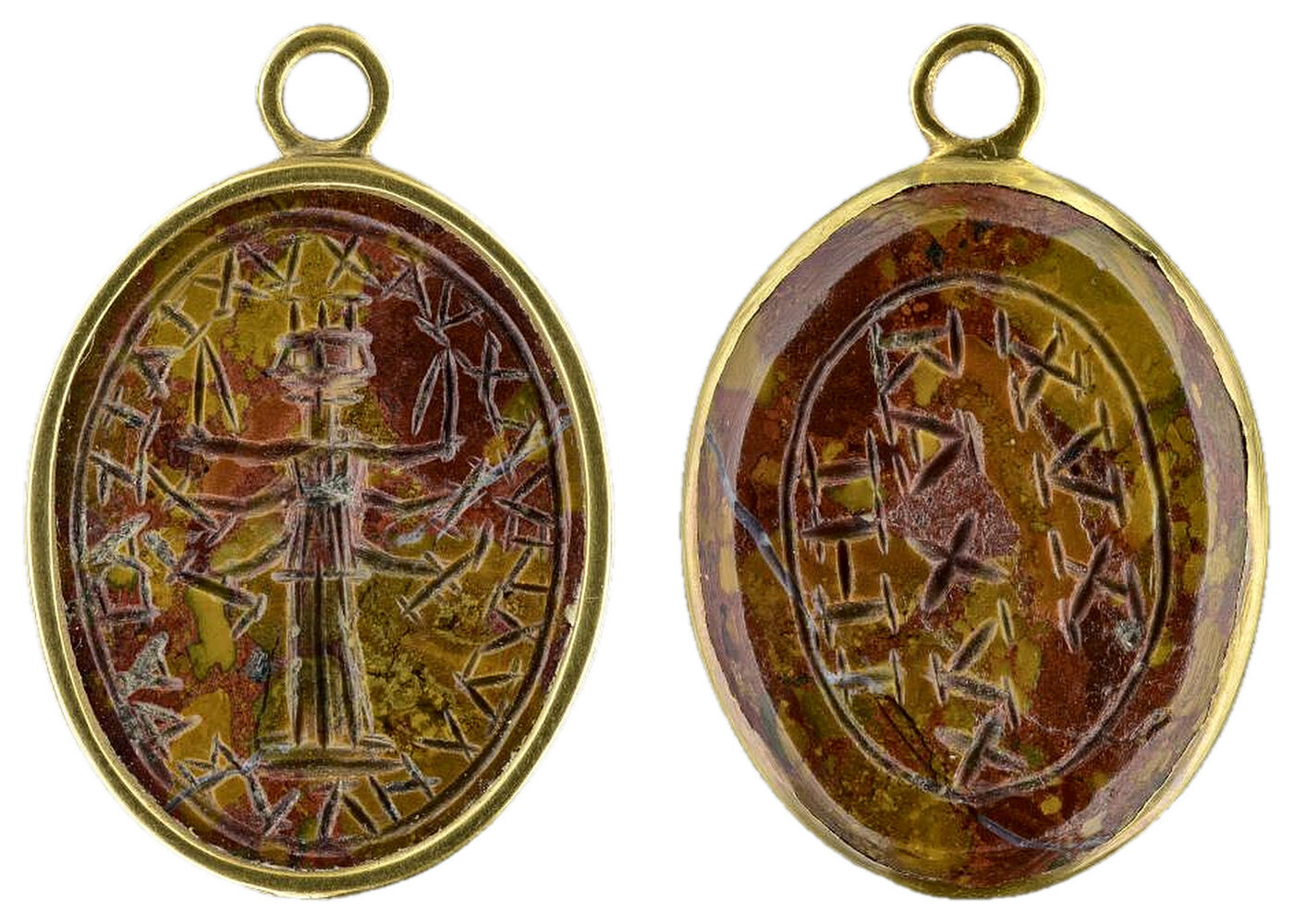
Triple Hecate with torches, daggers and whips; inscriptions on both faces. Yellow and red jasper, 19.8 × 15.4 mm, in a post-antique gold mount. Florence, Museo Archeologico Nazionale, inv. 15078.
Other figures appear beside them: Helios in his chariot, Aphrodite wringing out her hair, Anubis before the mummy of Osiris. Celestial symbols nearly always surround them and mark them as bearers of cosmic power.
The names: Abrasax, Iao, Sabaoth
Then come the inscriptions, in Greek letters.
The word Abrasax is engraved on a great many stones. In Greek, the numerical values of its letters add up to 365. The Church Fathers report that the followers of Basilides, in the second century, gave this name to the supreme God of the 365 heavens.
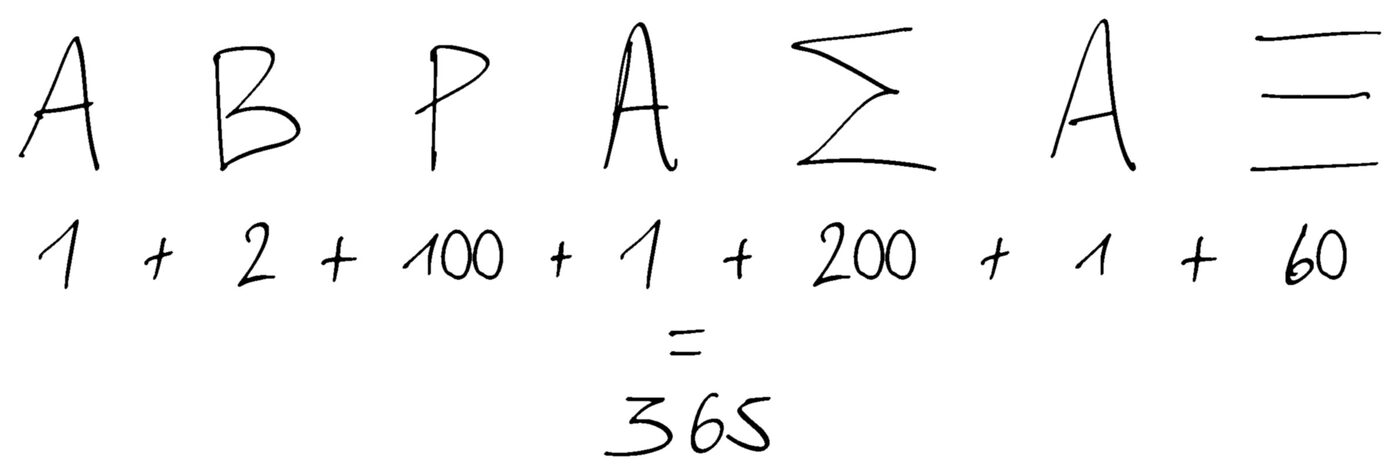
The name ΑΒΡΑΣΑΞ and the value of each of its letters. Drawing by Bianca Massard.
Abrasax and Iao are the commonest inscriptions beside the anguipede. They also occur on other types and need not refer to him, though scholars long assumed they did.
Iao is the Greek form of the name of the God of Israel. Sabaoth, ‘of hosts’, and Adonai, ‘my Lord’, also come from Hebrew. On a gem they are not just pious words. They are powers. One stone lists the seven archons of the Ophite Gnostics, the planetary lords: Ia, Iao, Sabaoth, Adonai, Eloai, Oreos, Astapheos.
Another name recurs, Ialdabaoth. In the Nag Hammadi texts, and for Irenaeus and Hippolytus, he is the arrogant, ignorant Creator whose influence the Gnostic must escape. Yet heterodox Jews in Egypt and pagans worshipped him, as a youthful, warlike manifestation of God. On gems he takes three forms: the scarab, the lion-headed warrior and the jackal-headed anguipede. The cockerel-headed anguipede is not one of them.
Other formulas cannot be translated. Ablanathanalba is a palindrome, a word that reads the same in both directions. Akrammachamari is another such formula. These voces magicae are strings of vowels and apparently meaningless syllables. They worked only in their original language, and to translate them was to drain them of force.
Gems and magical papyri share a repertoire. In the papyri Abrasax speaks in the first person: ‘I, Abrasax, shall deliver’, says a phylactery written to protect a child, little Sophia-Priskilla, from fever, ghosts and demons.
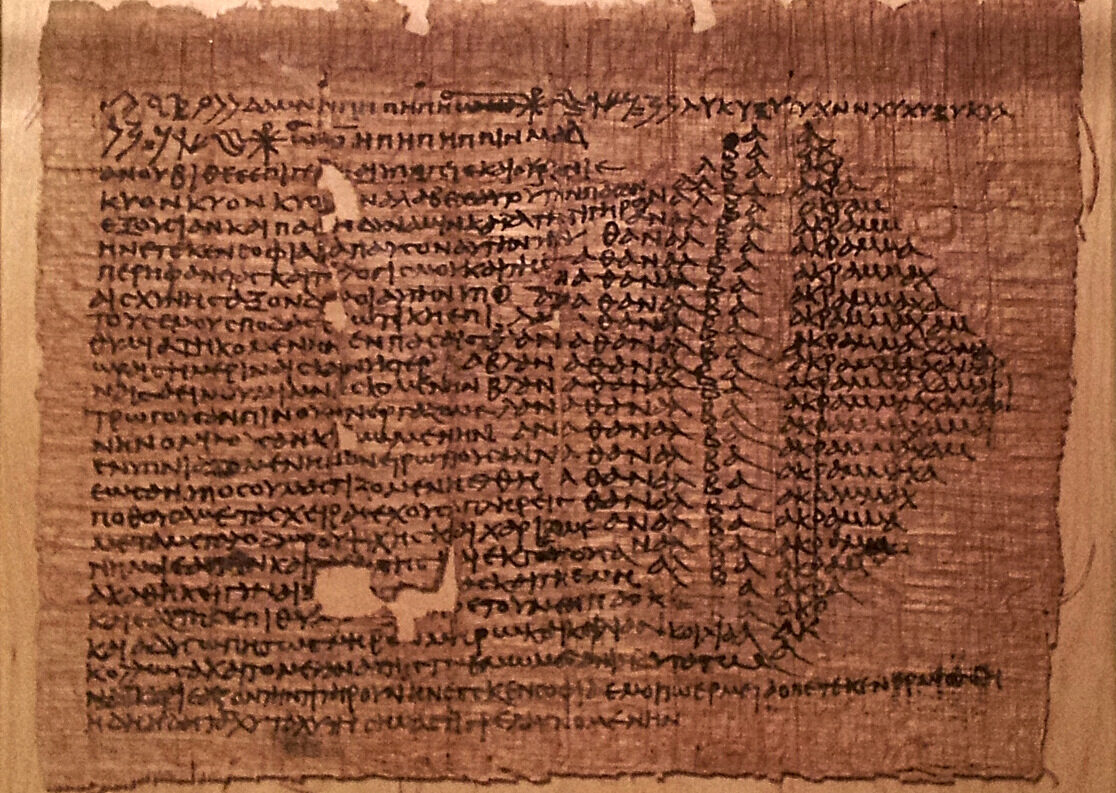
A love charm written for a man named Hermeias, with charakteres at the top and, to the right of the text, ABLANATHANALBA and AKRAMMACHAMARI. 4th century AD. Strasbourg, Bibliothèque nationale et universitaire, P. gr. 1167. Photo P. Tribhou, public domain.
Charakteres: the signs that are not letters
Charakteres are magical signs that look like writing but are not.
The signs are not ornament. One recipe in the papyri sets out six of them and then addresses them: ‘mighty gods, restrain…’, as if the signs were the gods themselves.
One of them is the sign of Chnoubis, three S’s crossed by a bar, often found on the back of stones with his image. For pain in the side, the physician Marcellus Empiricus recommends engraving it on a jasper and hanging it round the patient’s neck.
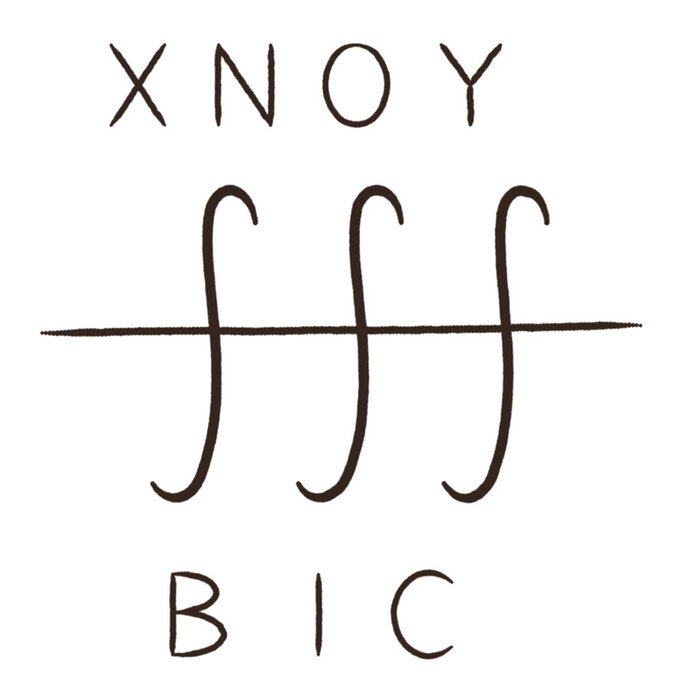
The sign of Chnoubis, between the letters of his name, ΧΝΟΥΒΙϹ. Drawing by Bianca Massard after a third-century chalcedony.
The sign has a history. In the tomb of Osorkon II at Tanis, the corresponding decan takes the form of a rearing snake whose body is crossed by other snakes. Attilio Mastrocinque offers two further readings. The three S’s could be read as three times the number six, or as the first letter of the name of God in ancient Hebrew script, written three times.
Another figure to know is the ouroboros, the snake that bites its tail and marks the boundary between being and nothingness. One London formulary even supplies a drawing of it, to be traced on a sheet of gold, silver or tin.
Turn the stone over
The backs of the anguipede gems can surprise. They carry inscriptions, in lines or inside an ouroboros, and sometimes other figures, Harpocrates on the lotus or Helios standing on a lion.
A Roman intaglio in the British Museum, engraved with Pan offering a cup to Isis-Tyche, was later given an anguipede on the back. An ordinary stone had been magically ‘charged’ after it was made. One stone can thus record two moments in its history.
The edge matters too. On a haematite in Perugia, magical signs run round the edge.
Stones engraved from books
The papyri sometimes explain how to engrave a stone. For the charm known as the ‘sword of Dardanos’, the great magical papyrus in Paris calls for Aphrodite riding Psyche to be engraved on magnetite, with Eros and Psyche embracing on the back. Once the stone is engraved and consecrated, the officiant puts it under his tongue and speaks the formula.
Two surviving gems show the subject.
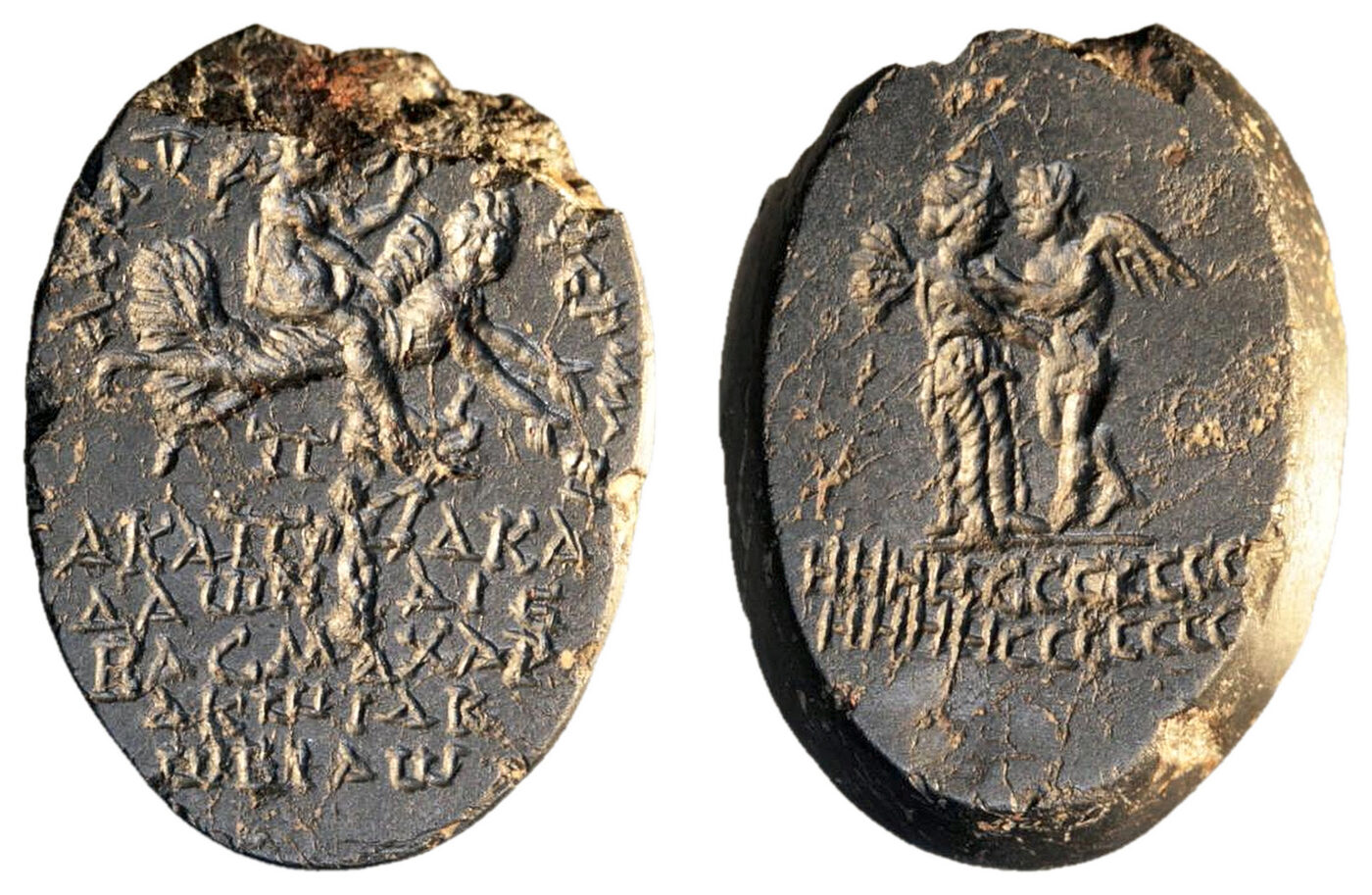
The gem of the ‘sword of Dardanos’. Aphrodite riding Psyche; on the reverse, Eros and Psyche embracing. Magnetite, 21.8 × 16.2 mm. Perugia, Museo Archeologico Nazionale dell'Umbria, inv. 1526.
The Leiden roll prescribes a jasper ‘the colour of air’ engraved with a snake biting its tail, the moon and the sun inside the circle and, on the back, the names Iao, Sabaoth, Abrasax.
Still, the papyri are not the pattern books of the gems. Morton Smith showed this in 1979. In the whole corpus only eighteen passages mention a gem. Conversely the anguipede, so common on the stones, is never described.
Smith concluded that the engravers used other books, now lost. A gem in Budapest keeps a trace of them. Above three deities, the engraver copied the words ‘as in the model’. The handbook’s instruction ended up on the stone along with the image.
What was the stone for?
Many magical gems are medical. Chnoubis protects the stomach, the haematites showing a womb locked with a key protect the womb, Perseus drives off gout, and the reaper eases the hips.
Ares, with the formula ‘Are you thirsty, Tantalus? Drink blood!’, stops bleeding. An agate asks for a woman called Gaia to be freed from fever, chills and headache. A specialist could therefore design a gem for one patient.
Other stones protect. Solomon on horseback spears a female demon, and Hecate kept demons away as well as the anguipede did.
Others serve love, like the Aphrodite wringing out her hair. A yellow jasper in Perugia with the griffin of Nemesis, paw on the wheel of fate, is probably an amulet for an athlete or gladiator.
Magic could also attack. A haematite in Berlin shows a skeleton driving a chariot drawn by two lions, which trample a second skeleton. It may be a curse on a charioteer.
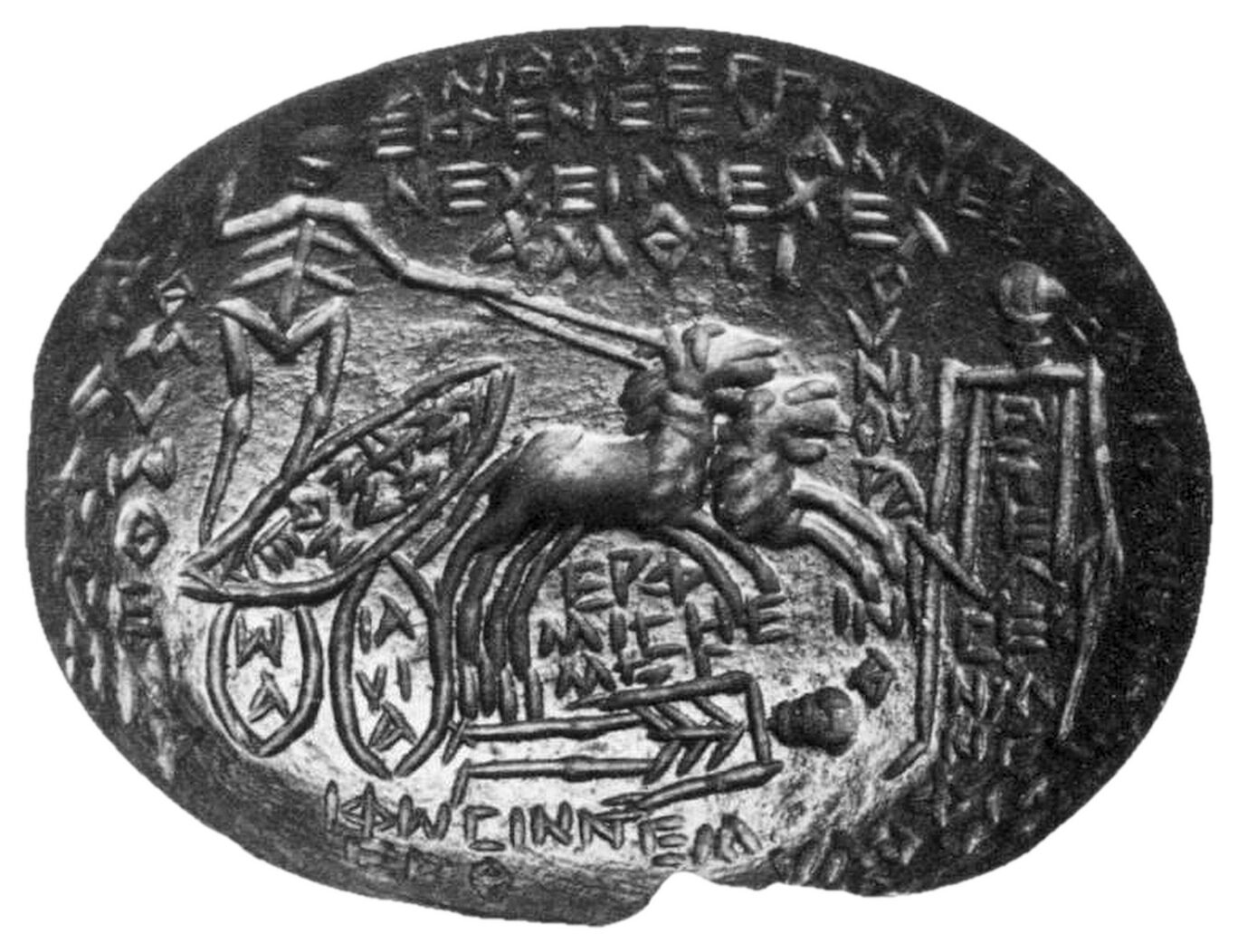
A chariot driven by a skeleton, drawn by two lions; inscriptions in the field. Haematite, 29.1 × 23 mm, about AD 200. Berlin, Staatliche Museen, Ägyptisches Museum, inv. 9885.
To own such a gem, Attilio Mastrocinque writes, was to keep a private, portable temple.
Where and when were they engraved?
No workshop has been excavated. Most of these stones come from the Near East and Egypt, and many engravers must have worked near sanctuaries. Stones were cut to order, with the owner’s name, or in series.
In the cities of the western provinces magical gems are rare and unlike local work, because they were imported.
It is generally agreed that most belong to the second and third centuries AD, with a peak under the Severans, when easterners newly made Roman citizens spread their cults. Since dated archaeological contexts are lacking, these dates should be taken as approximate.
Christian amulets, made after Constantine, continued into the Middle Ages, even though the Synod of Laodicea, in the fourth century, condemned clergy who made amulets.
All these images work the same way. A figure from one tradition takes attributes from another, a name from a third, and signs that belong to none.
This freedom to combine is what makes magical gems so rich. It is also what makes them so hard to authenticate. A copy that mixes disparate elements looks as plausible as an original, because the original is itself a mixture.
Frequently asked questions
What is an intaglio?
A stone engraved in hollow, the opposite of a cameo, which is carved in relief. Pressed into wax or clay, it leaves an impression in relief. The first purpose of an engraved stone was to seal.
What is a magical gem?
An engraved stone that is a talisman, not a seal, set in a ring or pendant. It shows hybrid creatures and syncretic gods, with inscriptions in Greek letters and signs, often on both faces.
How do you tell a magical gem from a seal?
By the direction of the writing. On a seal the inscription is cut in reverse, to be read on the impression. On a magical gem it reads correctly on the stone itself.
What does Abrasax mean?
It is a divine name. In Greek each letter stands for a number, and the letters of Abrasax add up to 365. According to the Church Fathers, the followers of Basilides gave this name to the supreme God of the 365 heavens. It is also written Abraxas.
Who is Iao?
Iao is the Greek form of YHWH, the name of the God of Israel. On gems the name also appears beside pagan figures.
What do Sabaoth and Adonai mean?
They are two Hebrew names of the God of the Bible. Sabaoth means ‘of hosts’, Adonai ‘my Lord’. On a gem they are not just pious words. They are powers.
What is the anguipede?
The word comes from the Latin for ‘snake-footed’. It is the commonest figure on magical gems, a man with a cockerel’s head and snakes for legs, in a cuirass, with a whip and a shield. We do not know his ancient name.
Is the anguipede a god or a demon?
Morton Smith noted that the gems never mention demons and that their magic is credited entirely to gods. Ialdabaoth, the arrogant, ignorant Creator of the Gnostics, takes other forms: the scarab, the lion-headed warrior, the jackal-headed anguipede.
Who is Chnoubis?
A snake with a lion’s head, often radiate, linked to one of the Egyptian decans. Cut on a green stone, he protects the stomach. His sign, three S’s crossed by a bar, often appears on the back.
What are charakteres?
Magical signs that look like writing but are not. They occur on gems and in the papyri, where one recipe addresses them as gods.
What are voces magicae?
Strings of vowels and apparently meaningless syllables. They worked only in their original language, and to translate them was to drain them of force.
What does Ablanathanalba mean?
It is a palindrome, a word that reads the same in both directions, and one of the formulas engravers cut on the backs of stones. Scholars have looked for the roots of such words mainly in Hebrew, and less often in Greek or Egyptian.
What is the ouroboros?
The snake that bites its tail. On gems it surrounds the figure or the names and marks the boundary between being and nothingness.
Gnostic gem or magical gem?
‘Gnostic’ comes from the Greek gnôsis, knowledge. Cardinal Baronius, on the trail of ancient heretics, was the first to call these gems ‘Gnostic’. Since the work of Armand Delatte and Campbell Bonner, most scholars have agreed that these amulets are magical rather than Gnostic, and were made by magicians of the imperial period.
How old are magical gems?
It is generally agreed that most belong to the second and third centuries AD, with a peak under the Severans. Christian amulets, made after Constantine, continued into the Middle Ages.
What stones are they made of?
More than a third are jasper and about another third haematite. Lapis lazuli and chalcedony are also used. The stone was chosen for its powers and matched to the complaint.
Who wore these stones?
The magicians sold their services widely, to initiates of the mystery cults as well as to the sick and the anxious. Roman law opposed magic, but every class of society used it, emperors included.
Are all magical gems ancient?
No. In the Middle Ages, and even more in the Renaissance, demand for these stones was so strong that copies were made in large numbers, and they are not always easy to spot.
Further reading
- C. Bonner, Studies in Magical Amulets, Chiefly Graeco-Egyptian, Ann Arbor, 1950.
- H. D. Betz (ed.), The Greek Magical Papyri in Translation, 2nd ed., Chicago, 1992.
- S. Michel, Die magischen Gemmen im Britischen Museum, London, 2001.
- A. Mastrocinque (ed.), Sylloge Gemmarum Gnosticarum I, Rome, 2004.
- A. Mastrocinque (ed.), Les intailles magiques du département des Monnaies, Médailles et Antiques, Paris, Éditions de la BnF, 2014.
- The Campbell Bonner Magical Gems Database, Budapest, Museum of Fine Arts (cbd.mfab.hu).
Image sources
The photographs of the gems in Naples (CBd-2198), Paris (CBd-3449), Perugia (CBd-4257 and CBd-4265), London (CBd-504), Hamburg (CBd-1669), Florence (CBd-4220) and Berlin (CBd-2141) come from the Campbell Bonner Magical Gems Database, which names the rights holders. The drawings of Doros's lathe and of the unfinished chalcedony come from the copy of Furtwängler digitised by Heidelberg University Library. The Strasbourg papyrus is a photograph by P. Tribhou, in the public domain. The Abrasax sum and the sign of Chnoubis are drawings by Bianca Massard.
Adapted from a study by Bianca Massard of Graeco-Roman magical gems (2026).
FOLLOW US ON INSTAGRAM
© 2026 ANTHEA FINE ARTS

Privacy policy
In line with government regulations regarding GDPR, below is the Privacy Policy of Anthea Fine Arts Ltd which outlines how we collect, store and process your data. If you have any questions, please contact us at customer@antheafinearts.com.
This policy applies to information held about clients and prospective clients, suppliers and prospective suppliers, contacts, and other persons about whom Anthea Fine Arts holds information. By ‘information,’ we mean personal information about you that we collect, use, share and store. In this policy, “we,” “us,” and “our” means Anthea Fine Arts Ltd, and “you” means the individual to whom the information relates.
WHAT WE COLLECT
Contact information such as your address, email address and telephone number; Proof of Residence (in the case of auctions)If relevant, your payment details / financial data i.e. your bank name, account number and sort code; Information related to your attendance of, and/or interest in, Anthea Fine Arts events, art works, artists and art fairs; Information about you that you give us in person at our auctions, events and exhibitions, by filling in cards we send you by post or forms on our site www.antheafinearts.com(our site) (e.g. the contact us section or to sign up to our mailing list) or by corresponding with us by phone, e-mail or otherwise; and Information in relation to your purchase of our merchandise or use of our services.
HOW WE COLLECT INFORMATION ABOUT YOU
Collecting information you give to us when you purchase any stock or visit us at each public auctions, or related event; Your use of the forms on our website or completion of card/forms we may provide in person or by post; From your agent or another person acting on your behalf including services such as Etsy and other art platforms and service providers.
WHAT WE DO WITH THE INFORMATION WE GATHER
We use your information to:
Provide information about our stock and Auctions services to you; Keep you informed about art, antiques, artists and events that we think you may find interesting; Carry out our obligations arising from any agreements entered into between you and us; Communicate with you Administer our site and for internal operations, including troubleshooting, data analysis, testing, marketing optimisation, research and statistical and survey purposes; Keep our site safe and secure; Comply with legal and regulatory obligations; and Security and to check your identity.
WHETHER INFORMATION HAS TO BE PROVIDED BY YOU, AND IF SO WHY
The provision of your personal details is required to sell and deliver an art work to you and for us to collect payment. If you do not provide this information we will not be able to perform our contract or enter into our contract with you and you may also be in breach of contract. We also require your personal details in order to send you marketing communications – you are not obliged to provide this information to us for this purpose.
LEGAL BASIS FOR PROCESSING
Our processing of your personal information is necessary:
For the performance of contracts to which you will be a party to and in order to take steps at your request prior to you entering into those contracts; For the purposes of legitimate interests pursued by us; or In order to comply with a legal obligation to which we are subject.
In relation to any processing of special categories of personal data, we will generally rely on obtaining specific consent from you at the time unless there is otherwise a legal requirement for us to process such information.
Where required for certain marketing activities we will obtain consent for this.
LEGITIMATE INTERESTS
Where our processing is based on the legitimate interest grounds described above, those legitimate interests are: (i) collecting personal information to provide you with a smooth and efficient client experience; (ii) to make sure you receive updated information on Anthea Fine Arts business activities; (iii) to provide the services you have requested; and (iv) for our own marketing and research.
SHARING YOUR INFORMATION
Except as expressly set out in this policy we will not sell, distribute or lease your personal information to third parties unless we have your permission or are required by law to do so. We may also share your personal information with:
Law enforcement agencies, other governmental agencies or third parties if we are required by law to do so Other business entities should we plan to merge with or be acquired by that business entity, or if we undergo a re-organisation with that entity.
TRANSFERRING YOUR INFORMATION OUTSIDE EUROPE
Your personal information may be transferred to, and stored at, a destination outside the European Economic Area (“ EEA“) and may also be processed by staff operating outside the EEA who work for us, or for one of our service providers. This may be in connection with an art fair or where we use certain offshore service providers, typically for IT and marketing services. When we, or our permitted third parties, transfer your information outside the European Economic Area, we or they will impose obligations on the recipients of that data to protect your information to the standard required in the European Economic Area or otherwise require the recipient to subscribe to international frameworks intended to enable secure data sharing. In the case of transfers by us, we may also transfer your information where: (i) the transfer is to a country deemed to provide adequate protection of your information by the European Commission; or (ii) where you have consented to the transfer. In general the safeguards we use to protect your personal information are the European Commission’s approved contract clauses, Privacy Shield where applicable and/or ensuring the country is deemed to have adequate protection. Please contact us (details below) if you wish to obtain further information about the safeguards we use for such international data transfers.
YOUR RIGHTS
At any time, you have the right (which in general is free of charge):
To request access to or a copy of any personal data which we hold about you; To rectification of your personal data, if you consider that the information we are holding is inaccurate; To ask us to delete your personal data, if you consider that we do not have the right to hold it; To withdraw consent to our processing of your personal data (to the extent such processing is based on previously obtained consent); To ask us to stop or start sending you marketing messages as described below in the marketing section; To restrict processing of your personal data; To data portability (moving some of your personal data elsewhere) in certain circumstances; To object to your personal data being processed in certain circumstances; and To not be subject to a decision based on automated processing and to have safeguards put in place if you are being profiled based on your personal data. Any request from you for access to or a copy of your personal data must be in writing and we will endeavour to respond within a reasonable period and in any event within one month in compliance with data protection legislation. We will comply with our legal obligations as regards your rights as a data subject.
We aim to ensure that the information we hold about you is accurate at all times. To assist us in ensuring that your information is up to date, do let us know if any of your personal details change at the following email address:customer@antheafinearts.com.
MARKETING
Where you are one of our clients or have otherwise provided us contact information for marketing purposes we may use your personal information to send you information by post or email about Anthea Fine Arts events, auctions, works of art and news. You can unsubscribe from receiving such communications at any time; details of how to unsubscribe from marketing emails will be included on each electronic mailing we send you.
You also have the option of “unsubscribing” from our mailing list at any time thereby disabling any further such e-mail and / or other communication from being sent to you by emailing customer@antheafinearts.com We will action any opt out request from you without delay.
Where we require your consent in order to send you certain marketing communications we will obtain this.
HOW LONG WILL WE KEEP YOUR INFORMATION?
We will only keep the information we collect about you for as long as required for the purposes set out above, for provenance/authenticity purposes or in relation to any potential disputes or as required to comply with any legal obligations to which we are subject. This will involve us periodically reviewing our files to check that information is accurate, up-to-date and still required.
Where we are entitled to send you direct marketing communications we may retain your contact information necessary for this purpose, for as long as you do not unsubscribe from receiving the same from us. If you opt out from marketing, we will retain your information to enable us to respect your wishes to not be contacted for marketing purposes.
SECURITY
We are committed to ensuring that your information is secure. In order to prevent unauthorised access or disclosure, we have put in place suitable physical, electronic and managerial procedures to safeguard and secure the information we collect online.
LINKS TO OTHER SITES
Our website may contain links to other sites, including via our social media buttons. While we try to link only to websites that share our high standards and respect for privacy, we are not responsible for the content, security, or privacy practices employed by other websites and a link does not constitute an endorsement of that website. Once you link to another website from our website you are subject to the terms and conditions of that website, including, but not limited to, its internet privacy policy and practices. Please check these policies before you submit any data to these websites. Certain features of our site may allow for social networking. You should ensure when using these features that you do not submit any personal data that you do not want to be sent, collected or used by other users, such as profile details or email address.
COMPLAINTS
Questions, comments and requests regarding this policy are welcomed and should be addressed to customer@antheafinearts.com If you have any concerns about our use of your information, you also have the right (as a UK resident) to make a complaint to the Information Commissioner’s Office, which regulates and supervises the use of personal data in the UK, via their helpline on 0303 123 1113.
HOW WE USE COOKIES
A cookie is a small file which asks permission to be placed on your computer’s hard drive. Once you agree, the file is added and the cookie helps analyse web traffic or lets you know when you visit a particular site.
We use traffic log cookies to identify which pages are being used. This helps us analyse data about web page traffic and improve our website in order to tailor it to customer needs. We only use this information for statistical analysis purposes and then the data is removed from the system.
A cookie in no way gives us access to your computer or any information about you, other than the data you choose to share with us.
You can choose to accept or decline cookies. Most web browsers automatically accept cookies, but you can usually modify your browser setting to decline cookies if you prefer. This may prevent you from taking full advantage of the website.
CHANGES TO THIS POLICY
Any changes we make to our policy in the future will be posted on this page and, where appropriate, notified to you by e-mail. Please check back frequently to see any updates or changes to our policy.
Cookie policy
This website uses cookies to ensure you get the best experience on our website.
THE TYPE OF INFORMATION WE COLLECT AND HOW.
Essential Cookies - The site owner has indicated that these are essential to the running of the site.
Cookie Guard - This cookie is essential for storing the status of your cookie choices whilst using this site.
ASP.NET Session - This cookie is used to track important logical information for the smooth operation of the site.
ASP.NET User Roles - This cookie is used to store information about authenticated user roles.
Non-Essential Cookies - The site owner has approved these cookies but you may turn them off.
Facebook - Facebook uses cookies to track the sites you visit.
Twitter- Twitter uses cookies to maintain widgets.
AddToAny does not directly set cookies. However, third-party services like Facebook, Twitter, and others may set cookies when you share content via their platforms. These cookies may track user interactions for analytics and personalization purposes. Disabling cookies will prevent social sharing functionality.
ShareThis - This cookie is set as part of the ShareThis service and monitors "click-stream" activity.
Google Analytics - These cookies are used to collect information about how visitors use our site. We use the information to compile reports and to help us improve the site. The cookies collect.
Terms & conditions for website use
October 17, 2023
The following are the terms and conditions (the "Terms") under which you (a "User") may use the website of Anthea Fine Arts (the "Company") at www.antheafinearts.com and/or any other addresses (any or all of which are herein referred to as the "Web Site"). Please read this page carefully. By accessing and using the Web Site, you accept and agree to be bound, without modification, limitation or qualification, by the Terms. The Company may, at its sole discretion, modify or revise the Terms at any time by updating the text of this page. You are bound by any such modification or revision and should therefore visit this page periodically to review the Terms.
Specific rules, in addition to these Terms, are provided with respect to transactions conducted on or in connection with the Web Site, and other rules may be provided for the use of certain other items, areas or services provided on or in connection with the Web Site, and you agree to be bound by such rules.
YOUR USE OF THE WEB SITE CONSTITUTES YOUR AGREEMENT TO ALL TERMS, CONDITIONS, AND NOTICES CONTAINED HEREIN OR OTHERWISE POSTED ON THE WEB SITE. (THE CONTENT OF SUCH AGREEMENT, INCLUSIVE OF THE TERMS AND ALL SUCH ADDITIONAL CONDITIONS AND NOTICES, ARE TOGETHER REFERRED TO HEREIN AS THE "AGREEMENT.") IF YOU DO NOT ACCEPT ANY OF THE PROVISIONS OF THE AGREEMENT, DO NOT USE THE WEB SITE.
Section 1. The Material on the Web Site
WARNING:The content of the Web Site is not intended for minors. Such content extends to a wide range of jewels, art and antiquities, is generally uncensored, and may include nudity or other graphic or literary content that some people may consider offensive, as well as access to live or electronic bidding on articles such as firearms and alcoholic beverages that may be harmful and/or illegal in the hands of minors and children and/or inappropriate for them to view or have access to. If you allow your child to use your computer, it is your responsibility to determine whether any of the services, content and subject matter displayed on the Web Site is inappropriate for your child, and to control the child's use of the computer accordingly. If you yourself find offensive content of the type referred to above, you should not use the Web Site.
The contents of the Web Site, such as text, graphics, images, audio, video, data, coding, scripts, computer programs and other material ("Material" or "Materials"), are protected by copyright under the laws of the United States as well as other countries, and are owned or controlled by the Company or by third parties that have licensed their Material to the Company. The Company authorizes you to view and download a single copy of the Material solely for your personal, noncommercial use, or in the case of dealers, to display to your clients solely for purposes of facilitating a transaction with the Company. The use of any software that is made available for downloading from the Web Site ("Software") is governed by the terms of the software license agreement accompanying such software (the "License Agreement"), and is conditioned on your agreement to be bound by the terms of the License Agreement. All rights in and to the Material not expressly granted to you in the Agreement are reserved. Neither the availability of, nor anything contained within the Web Site shall be construed as conferring any license under any of the Company's or any third party's intellectual property rights, other or further than as expressly provided in the foregoing provisions of this paragraph, whether by implication, estoppel or otherwise.
Unauthorized use of the Material may violate copyright, trademark, and other laws. You may not sell, prepare derivative works based on or modify the Material (including, without limitation, preparation of summaries of the Material or "thumbnails" of any images therein), or reproduce, publicly display, publicly perform, distribute, or otherwise use the Material in any way for any public or commercial purpose. The use of the Material or any portion thereof on any other web site, or in any publication, database, catalog or compilation, or in a networked computer environment for any purpose other than personal browsing of the Web Site without the express prior written permission of the Company is strictly prohibited. With respect to any copy you make of the Material within the scope of the limited personal license granted herein, you must retain therein, unmodified and unobscured, any and all copyright and other proprietary notices contained in the original Material. Some of the Material may contain digital "watermarks" to indicate their source and ownership. You agree not to attempt to remove, deactivate, reverse engineer, modify, tamper with or obscure any such watermarks. The trademarks, logos and service marks (the "Marks") displayed on the Web Site are owned by the Company or third parties. You are prohibited from using the Marks without the express, prior written permission of the Company or such third party. If you would like information about obtaining the Company's permission to use the Material on your web site, please email customer@antheafinearts.com.
You will not in any event use any robot, spider, scripts, service, software or any other automatic or manual device, tool, or process (a) for the purpose of compiling information regarding the identification, address or other attributes of any of our Users, bidders or sellers, or (b) to recreate in original or modified form any substantial portion of the Web Site or (c) to data mine or scrape any of the content on the Web Site, or (d) otherwise access or collect any of the Content, data, or information from the Web Site using automated means. You further agree not to (a) use services, software or any manual or automatic device, tool, or process to circumvent any restriction, condition, or technological measure that controls access to the Web Site in any way, including overriding any security feature or bypassing or circumventing any access or use controls of the Web Site, or (b) cache or archive any Content or (c) do anything that would impose an unreasonable or disproportionately large load on the Web Site, or (d) do anything that may disable, damage or change the appearance of the Web Site or interfere or attempt to interfere with the proper functioning of the Web Site or any transactions being conducted on or in connection with the Web Sites.
If you violate any provision of the Agreement, your permission to use the Material and the Web Site automatically terminates and you must immediately destroy any copies you have made of the Material.
The Company respects the intellectual property of others, and we ask our Users to do the same. If you believe that your work has been copied in a way that constitutes copyright infringement, please provide the Company's Copyright Agent the following information: an electronic or physical signature of the person authorized to act on behalf of the owner of the copyright interest a description of the copyrighted work that you claim has been infringed a description of where the Material that you claim is infringing is located on the site your address, telephone number, and e-mail address a statement by you that you have a good faith belief that the disputed use is not authorized by the copyright owner, its agent, or the law a statement by you, made under penalty of perjury, that the above information in your Notice is accurate and that you are the copyright owner or authorized to act on the copyright owner's behalf Notices of claims of copyright infringement should be directed to:
Anthea Fine Arts
111a High St Wealdstone
Harrow HA3 5DL
Attn: Director and Manager
Tel: 212-707-5941
customer@antheafinearts.com
Section 2. Privacy; User Submissions
The Company is committed to maintaining your privacy. The Company does, however, gather certain information that you provide to the Web Site. For information regarding the Company's policies for using User information please read our Privacy Policy.
The Company may provide certain areas of the Web Site (such as chat rooms, message boards or other facilities) designated as open to public access or to our Users at large (each of which is referred to herein as a "Public Area"). Generally, any communication that you post to a Public Area is considered to be non-confidential.
By posting communications (including any graphic or multimedia content) to any Public Area, you automatically grant the Company a royalty-free, perpetual, irrevocable non-exclusive license to use, reproduce, modify, publish, edit, translate, distribute, publicly perform, and publicly display the communication and any trademarks, names or likenesses therein alone or as part of compilations or other works in any form, media, or technology whether now known or hereafter developed, and to sublicense such rights through multiple tiers of sublicensees. (Provisions conferring similar rights on the Company may apply under separate terms or agreements with respect to certain matter submitted other than in Public Areas; you should check the applicable agreements or terms provided by the Company in order to ascertain your rights.)
The Company does not screen communications in advance and is not responsible for screening or monitoring material posted by Users. As a User, you are responsible for your own communications and are responsible for the consequences of their posting. You must not do any of the following things while accessing or using the Web Site or using the Material: (1) post or transmit any material unless you are the owner of all patent, trademark, copyright, trade secret or other proprietary rights ("Rights") therein, or have the permission of the owner of the Rights to post or transmit such material to the Web Site; (2) post material that otherwise violates any Rights of any third party or violates or infringes on the privacy or publicity rights of third parties; (3) post material that is obscene, defamatory, threatening, harassing, abusive, hateful, embarrassing or otherwise objectionable to another User or any other person or entity; (4) post sexually-explicit language or images; (5) post advertisements or solicitations of business; (6) post or transmit any chain letters or pyramid schemes; (7) impersonate another person or entity; (8) intentionally or unintentionally violate any applicable local, state, national or international law while using or accessing the Web Site or the Material; or (9) post or transmit any information containing a virus or other harmful component.
If notified by a User of communications that allegedly do not conform to any term of this Agreement, the Company may investigate the allegation and determine in its sole discretion whether to remove or request the removal of the communication. The Company has no liability or responsibility to Users for performance or non-performance of such activities. The Company reserves the right, in its sole discretion, to expel Users and prevent their further access to the Web Site for violating this Agreement or the law. The Company also reserves the right at all times to disclose any information as necessary or deemed desirable by the Company to satisfy any applicable law, regulation, legal process or governmental request, or to edit, refuse to post or to remove any information or materials, in whole or in part, in the Company's sole discretion.
THE COMPANY DOES NOT ENDORSE, SUPPORT, REPRESENT OR GUARANTEE THE TRUTHFULNESS, ACCURACY, OR RELIABILITY OF ANY COMMUNICATIONS POSTED BY OTHER USERS OR ENDORSE ANY OPINIONS EXPRESSED BY USERS. YOU ACKNOWLEDGE THAT ANY RELIANCE ON MATERIAL POSTED BY OTHER USERS WILL BE AT YOUR OWN RISK.
Section 3. Registration, Passwords and Signatures
In consideration of your use of the Web Site, you agree to: (a) provide true, accurate, current and complete information about yourself as prompted by any registration form that you may fill out on any Web Site (such information being the "Registration Data") and (b) maintain and promptly update the Registration Data to keep it true, accurate, current and complete. If you provide any Registration Data that is untrue, inaccurate, not current or incomplete, or the Company has grounds to suspect that such Registration Data is untrue, inaccurate, not current or incomplete, the Company has the right to suspend or terminate your account and refuse any and all current or future use of the Web Site (or any portion thereof).
You may receive a password and/or account designation, or a digital signature upon completing the registration process on the Company's Web Site. You are responsible for maintaining the confidentiality of any such password, digital signature and account, and are fully responsible for all activities that occur under your password, digital signature or account. You agree to (a) immediately notify the Company of any unauthorized use of your password, digital signature or account or any other breach of security, and (b) ensure that you exit from your account at the end of each session. The Company cannot and will not be liable for any loss or damage arising from your failure to comply with this paragraph.
We do not knowingly collect Personal Information from children under the age of 13 through the Web Site. If you are under 13, please do not give us any Personal Information. We encourage parents and legal guardians to monitor their children’s Internet usage and to help enforce our Privacy Policy by instructing their children to never provide Personal Information through any website without their permission. If you have reason to believe that a child under the age of 13 has provided Personal Information to us, please contact us, and we will endeavor to delete that information from our databases.
Section 4. Use of the Auction or Commerce Portions of the Web Site
The auction or commerce portions of the Web Site are available only to clients of the Company. This excludes in all cases minors (persons who have not reached their eighteenth birthday).
Section 5. Links to Other Sites
The Web Site may contain links to third-party web sites that are maintained by others. These links are provided solely as a convenience to you and not as an endorsement by the Company of the contents of such third-party web sites. The Company is not responsible for the content of linked third-party sites and does not make any representations regarding the content or accuracy of materials on such third-party web sites. If you decide to access linked third-party web sites, you do so at your own risk.
Section 6. Liability Disclaimers
The Material may contain inaccuracies or typographical errors. Except as may be separately specifically provided with respect to a particular sale, the Company makes no representations about the accuracy, reliability, completeness, or timeliness of the Material or about the results to be obtained from using the Web Site and the Material. Any use of the Web Site and the Material is at your own risk. Advice received via the Web Site should not be relied upon for personal, medical, legal or financial decisions and you should consult an appropriate professional for specific advice tailored to your situation. Changes are periodically made to the Web Site and may be made at any time. Some Material on the Web Site is provided by third parties and the Company shall not be held responsible for any such Material provided by third parties.
You acknowledge and agree that, in the event that there are discrepancies or differences between the descriptions of property provided on the Web Site, on the one hand, and the saleroom catalogue or saleroom addenda and announcements related to such property, on the other, the latter will in all events be considered to be authoritative and controlling.
THE COMPANY DOES NOT WARRANT THAT THE WEB SITE WILL OPERATE ERROR-FREE, CONTINUOUSLY OR WITHOUT INTERRUPTION, OR THAT THE WEB SITE OR ITS SERVER ARE FREE OF COMPUTER VIRUSES OR OTHER HARMFUL CONTENT. IF YOUR USE OF THE WEB SITE OR THE MATERIAL RESULTS IN THE NEED FOR SERVICING OR REPLACING EQUIPMENT OR DATA, THE COMPANY IS NOT RESPONSIBLE FOR THOSE COSTS.
THE WEB SITE AND MATERIAL ARE PROVIDED ON AN "AS IS" BASIS WITHOUT ANY WARRANTIES OF ANY KIND. THE COMPANY AND ITS SUPPLIERS, TO THE FULLEST EXTENT PERMITTED BY LAW, DISCLAIM ALL WARRANTIES, INCLUDING THE WARRANTY OF MERCHANTABILITY, NON-INFRINGEMENT OF PROPRIETARY OR THIRD-PARTY RIGHTS, AND THE WARRANTY OF FITNESS FOR PARTICULAR PURPOSE. THE COMPANY AND ITS SUPPLIERS MAKE NO WARRANTIES ABOUT THE ACCURACY, RELIABILITY, COMPLETENESS, OR TIMELINESS OF THE MATERIAL, SERVICES, SOFTWARE TEXT, GRAPHICS, AND LINKS. SOME STATES/ JURISDICTIONS DO NOT ALLOW THE DISCLAIMER OF IMPLIED WARRANTIES, SO THE FOREGOING DISCLAIMER MAY NOT APPLY TO YOU. THIS WARRANTY GIVES YOU SPECIFIC LEGAL RIGHTS AND YOU MAY ALSO HAVE OTHER LEGAL RIGHTS WHICH VARY DEPENDING ON YOUR STATE/JURISDICTION.
Section 7. Disclaimers of Certain Damages
IF YOU ARE DISSATISFIED WITH ANY PORTION OF THE WEB SITE, OR WITH ANY PROVISION OF THE AGREEMENT, YOUR SOLE AND EXCLUSIVE REMEDY IS TO DISCONTINUE USING THE WEB SITE. UNDER NO CIRCUMSTANCES SHALL THE COMPANY BE LIABLE TO ANY USER OR ANY THIRD PARTY ON ACCOUNT OF THAT USER'S USE OF THE WEB SITE. IN NO EVENT SHALL THE COMPANY AND/ OR ITS SUPPLIERS BE LIABLE TO YOU OR ANY SUCH THIRD PARTY FOR ANY DIRECT, INDIRECT, PUNITIVE, EXEMPLARY, INCIDENTAL, SPECIAL OR CONSEQUENTIAL DAMAGES OR ANY DAMAGES WHATSOEVER, INCLUDING, WITHOUT LIMITATION, DAMAGES FOR LOSS OF USE, DATA OR PROFITS, ARISING OUT OF OR IN ANY WAY CONNECTED WITH THE USE OR PERFORMANCE OF THE WEB SITE, THE DELAY OR INABILITY TO USE THE WEB SITE, THE PROVISION OF OR FAILURE TO PROVIDE SERVICES, OR FOR ANY INFORMATION, SOFTWARE, PRODUCTS, SERVICES AND RELATED GRAPHICS OBTAINED THROUGH THE WEB SITE, OR OTHERWISE ARISING OUT OF THE USE OF THE WEB SITE, WHETHER BASED ON CONTRACT, TORT, STRICT LIABILITY OR OTHERWISE, EVEN IF THE COMPANY OR ANY OF ITS SUPPLIERS HAS BEEN ADVISED OF THE POSSIBILITY OF DAMAGES. BECAUSE SOME STATES/JURISDICTIONS DO NOT ALLOW THE EXCLUSION OR LIMITATION OF LIABILITY FOR CONSEQUENTIAL OR INCIDENTAL DAMAGES, THE ABOVE LIMITATIONS MAY NOT APPLY TO YOU.
Section 8. Indemnity
You agree to defend, indemnify, and hold harmless the Company, its officers, directors, employees and agents, from and against any losses, liabilities, damages, costs, and expenses, including, without limitation, reasonable legal, expert and accounting fees, incurred in connection with any claims, actions or demands alleging or resulting from your use of the Material (including Software), your breach of this Agreement, or your violation of law or of the rights of any third party. The Company shall provide notice to you promptly of any such claim, suit, or proceeding and, if it is one asserted by a third party, shall provide reasonable assistance to you, at your expense, in defending any such claim, suit or proceeding.
Section 9. Import and Export Regulations Regarding Tangible Property
The United Kingdom and most foreign countries regulate the importation and exportation of tangible property. Many countries require a declaration of export for property that is leaving the country. Additionally, most countries require an Import Declaration at the time of customs clearance of property into that country. Upon import, these countries may impose duties, other taxes and/or restrictions on the property. Many countries also prohibit or restrict importation or exportation of property containing ivory, tortoiseshell, whalebone, and/or products derived from other endangered or protected species, and require special licenses or permits in order to import or export such property. Other countries regulate movement of antiquities and cultural items, which in some cases are subject to a right of pre-emption or compulsory purchase by the country from which they are to be exported. It is the responsibility of the seller to ensure that the item is properly and lawfully exported from the country in which it is located. It is the responsibility of the buyer to ensure that the property is properly imported into the buyer's country. If you participate in the auction or commerce portions of the Web site, and, as a result, purchase property that you plan to ship to another country, you agree that you are responsible for familiarizing yourself with and complying with any and all applicable rules and regulations.
THE COMPANY MAKE NO REPRESENTATION OR WARRANTY AND ACCEPTS NO LIABILITY WHATSOEVER TO THE SELLER, THE BUYER, OR ANY THIRD PARTY IN RESPECT OF THE AVAILABILITY OR ISSUANCE OF VALID IMPORT AND EXPORT PERMITS OR THE EXISTENCE OR EXERCISE OF PRE-EMPTION OR OTHER RIGHTS TO PURCHASE BY GOVERNMENTAL OR REGULATORY AUTHORITIES ANYWHERE.
Section 10. General
If any part of the Terms of Use is held unlawful or unenforceable that part shall be struck out and the remaining terms shall remain in effect. We hereby exclude to the fullest extent permitted by law, any rights of third parties.
1. Neither we, nor you, shall be liable for any failure of, or delay in, the performance of each of our respective obligations for the period that such failure or delay is due to causes beyond our respective reasonable control, including, but not limited to, acts of God, pandemics, war, fire, terrorist activity, strikes or labour disputes, embargoes, or government orders or regulation.
2. Any notice pursuant to or in connection with these Terms of Use shall be in writing and delivered by hand or by post to our registered office or by email to customer@antheafinearts.com, and in the case of us sending a notice to you, to the email address or postal address provided to us by you via our Website. Notices are deemed delivered on delivery if by hand or the third day after posting, or if delivered by email, immediately upon transmission if transmitted during normal business hours in the country of the recipient, or otherwise on the following business day.
3. The Terms of Use and any non-contractual obligations arising from or in connection with it or its subject matter or formation (including non-contractual disputes or claims), shall be governed by, and construed in accordance with the law of England and Wales and shall be subject to the non-exclusive courts of England and Wales.
Designed and powered by Masterart